

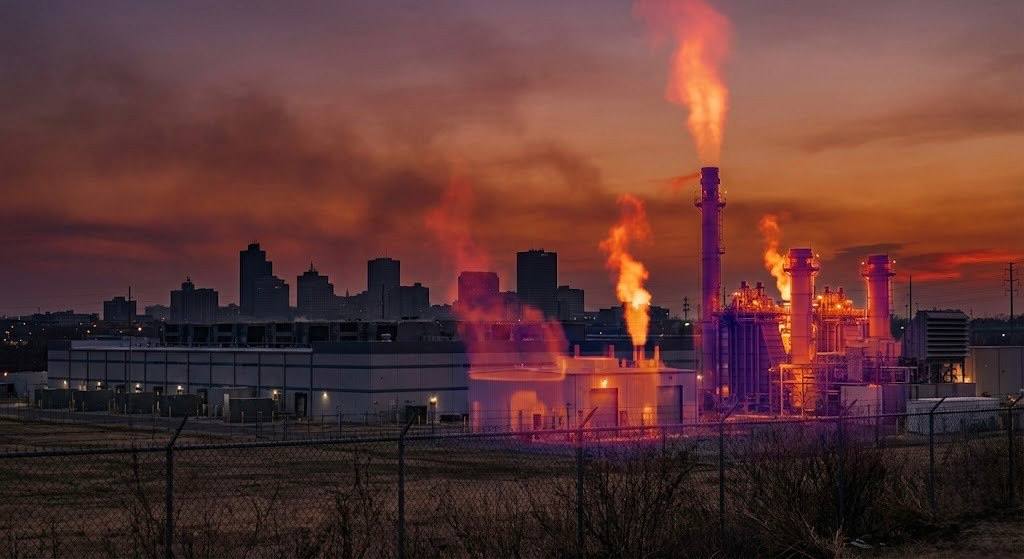
During a golden sunset in Memphis last May, Sharon Wilson pointed a thermal imaging camera at Elon Musk’s flagship data center. What she captured revealed a planetary threat invisible to the naked eye.
The gas-fired turbines powering the world’s biggest AI supercomputer were pumping vast plumes of methane into the Tennessee sky. No pollution controls. No permits. Just raw emissions flooding into an already overburdened community.
“It was jaw-dropping,” said Wilson, a former oil and gas worker who has documented methane releases for over a decade. “Just an unbelievable amount of pollution.”
The Memphis Case Study
xAI’s Colossus facility represents the dark side of the AI gold rush. When Musk couldn’t secure enough grid power for his supercomputer, he brought in 35 portable gas turbines without environmental permits or pollution controls.
The Southern Environmental Law Center estimates these turbines make xAI the largest industrial source of smog-forming pollution in Memphis. The facility increases the city’s nitrogen oxide emissions by 30 to 60 percent.
Memphis already struggles with severe air quality problems. The American Lung Association gave Shelby County an “F” grade for ozone pollution. Boxtown, the neighborhood closest to the xAI facility, faces cancer rates four times the national average.
“I have shot video all over the U.S., all over the UK, and in Japan,” Wilson said. “I’ve never seen anything that bad.”
The NAACP filed a lawsuit against xAI for Clean Air Act violations. The organization’s president Derrick Johnson called it environmental injustice: billion-dollar companies setting up polluting operations in Black neighborhoods without permits, thinking they’ll get away with it.
The Broader Crisis
Memphis is not an isolated case. The AI arms race has pushed Big Tech to abandon climate commitments at alarming speed.
Between 2020 and 2023, indirect carbon emissions from major tech giants increased by 150 percent. Given the pace of AI expansion, that figure is already outdated.
The International Energy Agency projects data center electricity consumption will double between 2022 and 2026, reaching 1,000 terawatt-hours. That equals Japan’s entire annual electricity consumption.
Energy and Water Demands
A typical AI data center consumes electricity equivalent to 100,000 households. The largest facilities under development will use 20 times that amount.
Water consumption adds another dimension. Each 100-word AI prompt uses approximately one bottle of water for cooling. A medium-sized data center drinks up to 110 million gallons annually, equivalent to 1,000 households.
Cornell University researchers calculated that by 2030, AI could emit 24 to 44 million metric tons of carbon dioxide annually. That equals adding 5 to 10 million cars to U.S. roads. Water consumption could reach 731 to 1,125 million cubic meters per year.
A ChatGPT query consumes roughly five times more electricity than a simple web search. But users have no way to know their individual AI footprint.
Regional Impacts
The strain falls disproportionately on specific regions. In Virginia, data centers already consume 26 percent of the state’s electricity. In Dublin, the figure reaches 79 percent.
Ireland could see data centers consuming 35 percent of national electricity by 2026. Half of projected U.S. electricity demand growth through 2030 will come from data centers.
Local communities are pushing back. In Franklin, Indiana, residents successfully blocked a proposed Google data center campus. Concerns about water and electricity consumption drove the opposition.
In Texas, data center developers are building their own gas plants disconnected from the grid. In Oregon, Google’s facilities use more than a quarter of the city water supply in The Dalles.
The Climate Contradiction
Tech companies promote AI as a tool to fight climate change. The technology does show promise for applications like mapping methane emissions and optimizing energy systems.
But the contradiction is glaring. Companies building AI to solve environmental problems are simultaneously accelerating environmental damage.
The problem extends beyond operations. Manufacturing GPUs requires more energy than producing simpler processors. Mining rare elements for hardware often occurs unsustainably. Electronic waste from rapid hardware turnover compounds the impact.
“Even if each kilowatt-hour gets cleaner, total emissions can rise if AI demand grows faster than the grid decarbonizes,” said Fengqi You, professor at Cornell Engineering.
What Can Be Done
Researchers identify several potential solutions. More efficient chips and training algorithms can reduce energy demands. Advanced liquid cooling systems cut water usage significantly.
MIT researchers suggest simple operational changes could reduce data center emissions by 10 to 20 percent. Software designed to shift workloads to low-carbon periods can optimize energy use.
The United Nations Environment Programme recommends standardized environmental measurement procedures, mandatory disclosure requirements, and integration of AI policies into broader environmental regulations.
But transparency remains the fundamental barrier. Most tech companies won’t disclose detailed energy and water consumption data. Without transparency, accountability becomes impossible.