

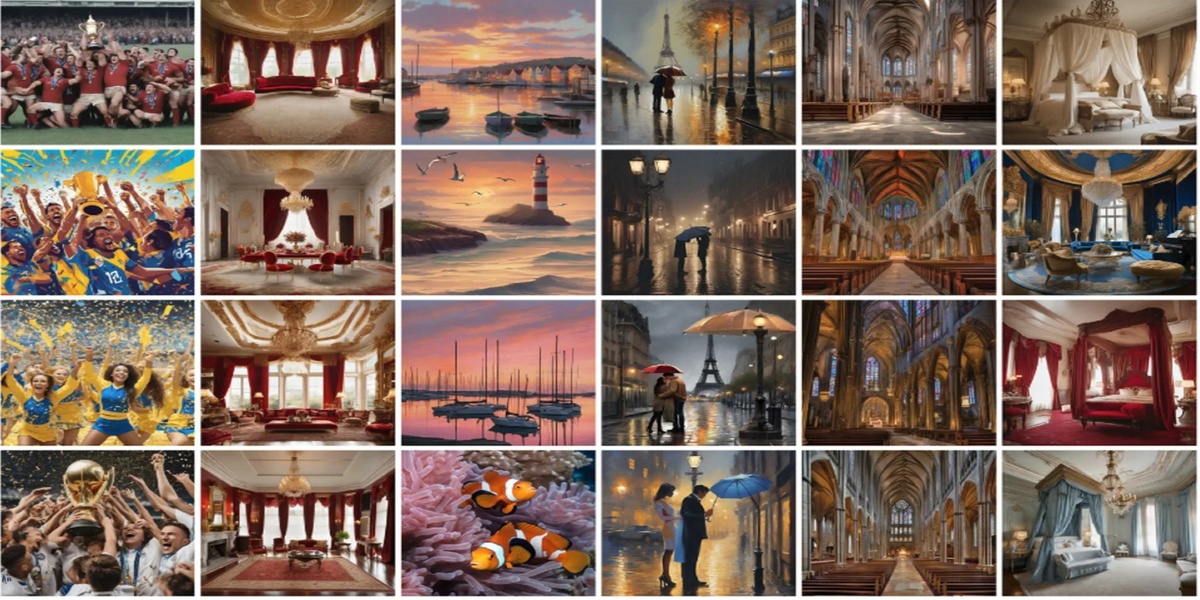
Artificial intelligence image generators promise limitless creative possibilities, but new research suggests they’re far more predictable than advertised. A study published in the journal Patterns reveals that popular AI models consistently gravitate toward just a dozen generic visual styles, regardless of how diverse or unusual the initial prompts may be.
Researchers tested two prominent AI systems, Stable Diffusion XL and LLaVA, using an ingenious experimental design modeled after the classic telephone game. The findings raise important questions about the true creative capabilities of generative AI and the homogenization of AI produced visual content.
The Digital Telephone Experiment
The research team designed a clever test to observe how AI image generators behave when left to their own devices. They started by feeding Stable Diffusion XL a complex text prompt, such as “As I sat particularly alone, surrounded by nature, I found an old book with exactly eight pages that told a story in a forgotten language waiting to be read and understood.”
The model generated an image based on that description. That image was then shown to LLaVA, a different AI model trained to describe visual content. LLaVA produced a new text description of what it saw, which was fed back into Stable Diffusion to create another image. This cycle repeated for 100 rounds.
Much like the human version of telephone, the original prompt quickly became unrecognizable. Previous experiments have demonstrated this phenomenon, with time-lapse videos showing how AI-generated images degrade when repeatedly processed. However, the Stanford and MIT researchers behind this study discovered something more troubling than simple degradation.
Twelve Styles to Rule Them All
Across 1,000 different runs of the telephone game, the researchers observed a striking pattern. No matter how unique or specific the starting prompt, the image sequences inevitably converged on one of just 12 dominant visual motifs. The researchers weren’t particularly complimentary about these common styles, describing them as “visual elevator music,” the kind of generic artwork you’d expect to see decorating a hotel corridor.
The most frequently occurring styles included maritime lighthouses, formal interiors, urban night scenes, and rustic architecture. In most cases, the transition happened gradually over dozens of iterations. Occasionally, the shift occurred suddenly. But it almost always happened.
When the researchers extended some experiments to 1,000 iterations, the convergence still occurred around the 100-turn mark. The additional 900 rounds produced variations, but these offshoots typically remained tethered to one of the original 12 popular motifs. Even switching to entirely different AI models for generation and description produced similar results.
What This Reveals About AI Creativity
The findings expose a fundamental limitation in current generative AI systems. Unlike human creative processes, which introduce genuine unpredictability through individual perspectives, experiences, and preferences, AI models exhibit the opposite tendency. They gravitate toward a narrow band of “safe” aesthetic choices embedded in their training data.
In a human game of telephone, extreme variance emerges because each participant hears, interprets, and retransmits information through their unique cognitive filter. AI lacks this individuality. According to research from institutions like MIT studying machine learning behavior, these models optimize for probability rather than originality, always selecting outputs that align most closely with patterns in their training datasets.
The study suggests that AI image generators are essentially sophisticated copying machines rather than creative engines. They excel at replicating and recombining existing visual styles but struggle to generate truly novel aesthetic approaches.
The Training Data Question
There’s an important caveat to consider. AI models learn from human-created images, which means their limitations may partly reflect our own biases. If photographers and artists disproportionately capture certain types of scenes, lighthouses at sunset or cozy rustic cabins, the AI will naturally favor these motifs.
This raises questions about whether the problem lies with the AI itself or with the datasets used to train it. Stability AI, the company behind Stable Diffusion, has previously acknowledged challenges in ensuring diverse and representative training data. However, the research suggests the issue goes deeper than dataset curation. Even with access to billions of varied images, the models still default to a remarkably narrow aesthetic range.
Implications for Creative Industries
For creative professionals, these findings carry mixed implications. On one hand, they suggest that AI tools won’t easily replace human creativity, particularly when it comes to developing distinctive visual styles or breaking aesthetic conventions. The research demonstrates that AI, left to its own devices, produces predictably generic results.
On the other hand, the study highlights how AI-generated content might contribute to visual homogenization across digital spaces. As these tools become more prevalent in content creation, from social media posts to marketing materials, we may see an increasingly uniform visual landscape dominated by those 12 safe, hotel-art aesthetics.
Beyond Imitation: The Challenge Ahead
The researchers concluded with a pointed observation: copying styles is considerably easier than teaching taste. This distinction captures the current state of generative AI. These systems can brilliantly mimic existing visual languages and blend different styles together, but they cannot develop genuine aesthetic judgment or push creative boundaries in meaningful ways.
As AI image generation technology continues to evolve, developers face a significant challenge. Creating systems that can truly innovate rather than iterate will require more than larger datasets or more sophisticated neural networks. It may demand fundamentally different approaches to how these models learn and generate visual content.
For now, the study serves as a reminder that artificial intelligence, despite its impressive capabilities, remains bound by the patterns in its training data. True creativity, it seems, still requires something that current AI models lack: the ability to venture into genuinely uncharted aesthetic territory.