

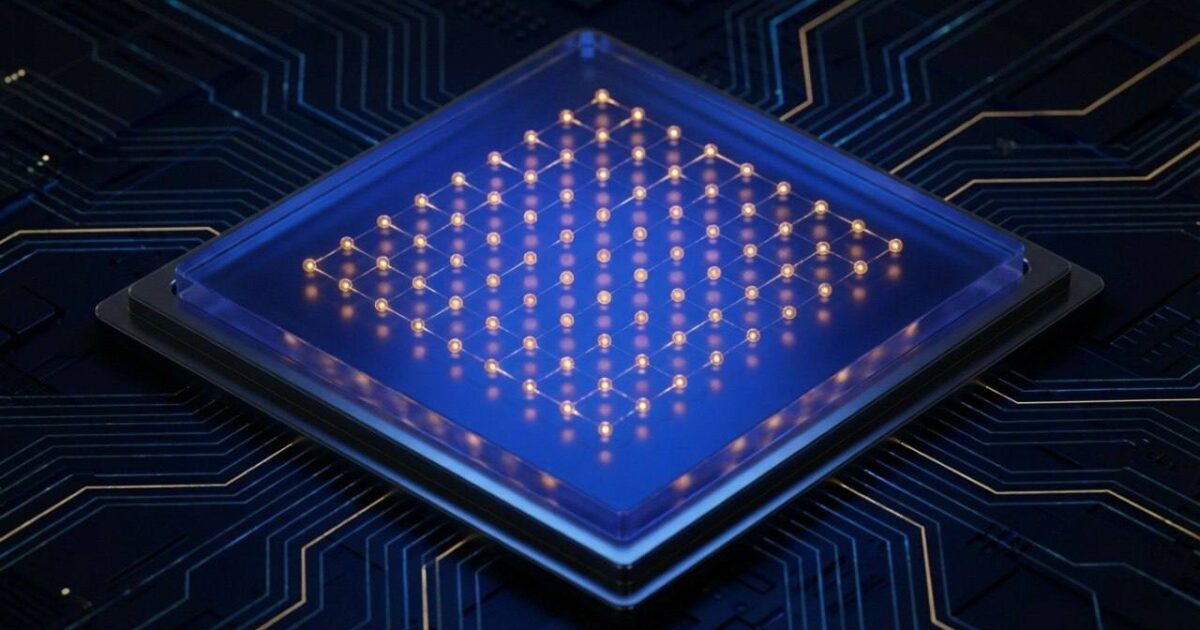
Sydney-based Silicon Quantum Computing has developed an 11-qubit processor that achieves up to 99.99% accuracy. The chip outperforms systems from IBM and Google without requiring additional error correction.
The research, published in Nature on December 17, demonstrates a new architecture called “14/15” that places phosphorus atoms within pure silicon wafers with atomic precision.
Quality Over Quantity
While tech giants race to build systems with hundreds or thousands of qubits, SQC took a different path. The company focused on precision manufacturing at 0.13 nanometers, roughly two orders of magnitude finer than standard TSMC chip production.
This atomic-level accuracy allows SQC to place individual phosphorus atoms exactly where needed within ultra-pure silicon wafers.
“In most quantum systems, scale comes at the cost of performance,” said CEO Michelle Simmons. “Our system increases in quality as it scales.
It’s a reflection of our careful choices in materials, architecture and modality, which puts us on track to deliver the world’s first commercial-scale quantum computer.”
The processor uses nine nuclear spin qubits and two electron qubits arranged in two separate registers. One register contains four phosphorus atoms while the other holds five, with each register sharing an electron spin.
The two registers connect through electron exchange interaction, enabling communication across the entire system. Unlike competing platforms, SQC’s design showed improved performance as more qubits were added.
The 14/15 Architecture Explained
The name “14/15” refers to the periodic table positions of silicon and phosphorus, the only two elements used in SQC’s quantum chips. This simplicity stands in contrast to other quantum computing approaches that require complex materials and control structures.
Nuclear spin qubits offer a key advantage over other qubit types. They maintain quantum information for seconds rather than microseconds, giving the system longer coherence times.
This stability comes from the natural properties of phosphorus atoms embedded in isotopically purified silicon-28.
SQC’s manufacturing process, developed over 25 years, uses scanning tunneling microscopy combined with epitaxial growth. The technique allows researchers to design atomic interactions with sub-nanometer precision, essentially building chips atom by atom.
No Error Correction Needed
Quantum computers typically struggle with errors caused by heat and electromagnetic interference. External disturbances can flip qubit states or introduce phase errors, corrupting calculations.
Most companies address this through massive error correction overhead, using thousands of physical qubits to create fewer reliable logical qubits.
SQC’s silicon-based approach minimizes bit flip errors due to its atomic-level precision. The system achieved 98.87% accuracy on Grover’s algorithm, a standard benchmark test designed in 1996 to measure quantum advantage, without running any error correction.
“We have these long coherence times of the nuclear spins and we have very little what we call bit flip errors,” Simmons explained. “So our error correction codes themselves are much more efficient. We really only have to correct for phase errors, so the error correction codes are much smaller.”
The researchers demonstrated Bell-state fidelities ranging from 91.4% to 99.5% within registers and from 87.0% to 97.0% across registers. Entanglement was preserved for up to eight nuclear spins simultaneously.
Competing Approaches Fall Behind
Google and IBM have built quantum systems using superconducting qubits with gated circuits. These systems now contain hundreds of qubits but require extensive error correction infrastructure.
Other companies like IonQ work with trapped ions held by laser tweezers, while PsiQuantum develops photonic qubits using particles of light.
Each approach faces the same fundamental challenge: adding more qubits typically increases noise and error rates. SQC claims to have solved this problem by achieving the opposite result, where quality improves alongside quantity.
Simon Segars, SQC Chair and former ARM CEO, called the results “the elegance and powerful simplicity of SQC’s approach.”
Commercial Progress and Future Plans
The company has already moved beyond laboratory demonstrations. Telstra reported significant reductions in model training time using SQC’s quantum machine learning systems.
Australian Defence purchased a rack-mounted quantum system for deployment within its datacenter environment.
SQC also advanced to Stage B of DARPA’s Quantum Benchmarking Initiative, a rigorous U.S. government program that validates different approaches to building quantum computers. The company will now develop a detailed research and development roadmap through 2033.
The startup’s first commercial product, a quantum machine learning processor called Watermelon, serves customers including Commonwealth Bank of Australia.
SQC announced a partnership with NVIDIA in October 2025 to develop NVQlink, high-speed GPU interconnects for quantum computers.
Path to Millions of Qubits
SQC believes its modular architecture can scale to millions of qubits. The 11-qubit processor serves as proof that multiple registers can connect while maintaining high fidelity.
By linking additional clusters using the same electron exchange mechanism, the company aims to build commercially viable quantum computers.
“Our research marks a milestone in the journey from experimental quantum devices to practical, modular and scalable machines,” the research team wrote. “We have demonstrated technical mastery and laid key groundwork for a quantum computing future.”
The silicon-based approach offers another advantage: compatibility with existing semiconductor manufacturing infrastructure. Trillions of dollars have been invested globally in silicon fabrication, wafer purification, and chip design.
A quantum platform that leverages this foundation could scale faster than alternatives requiring entirely new manufacturing processes.
Founded in 2017 with backing from the Australian Commonwealth Government, Commonwealth Bank of Australia, Telstra, and UNSW Sydney, SQC operates as the only private quantum computing company that manufactures its own quantum processing units entirely in-house.