

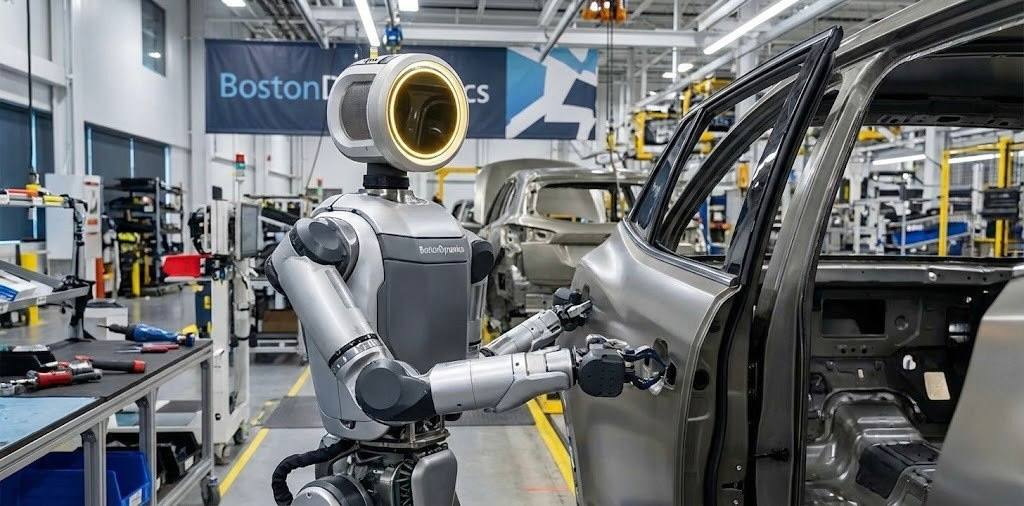
Boston Dynamics has officially unveiled the commercial version of its humanoid robot Atlas. The production model targets warehouses and factory environments worldwide.
After years of research and development, the robotics company is finally bringing Atlas to market. The first customer will be Hyundai, which owns 88 percent of Boston Dynamics.
Technical Specifications
The new Atlas stands 1.9 meters tall with an impressive 2.3-meter reach. It can repeatedly lift loads weighing up to 30 kilograms without performance degradation.
The robot operates on electric power and utilizes advanced Nvidia chips for processing. Battery life reaches approximately four hours of continuous operation.
Atlas can swap its own batteries in under three minutes when power runs low. All limbs can be replaced in less than five minutes for quick maintenance.
The robot functions reliably in temperatures ranging from -20 to 40 degrees Celsius. This makes Atlas suitable for various industrial environments and climate conditions.
Hyundai Partnership and Production
Hyundai will receive the first fleet of Atlas robots at its facilities in 2026. The robots will operate at the Robotics Metaplant Application Center.
In October 2025, Boston Dynamics tested a research model at a Hyundai factory in Georgia. The 1.75-meter tall prototype successfully sorted roof racks for the assembly line.
Hyundai is now building a new robotics factory capable of producing thousands of units annually. This marks a significant step toward mass production of humanoid robots.
Boston Dynamics expects most customers to see return on investment within two years. The company positions Atlas as a solution for heavy and repetitive industrial tasks.
AI-Powered Learning System
Atlas does not rely on traditional manual programming methods. Instead, the robot learns through advanced machine learning techniques.
Human workers guide Atlas through tasks using VR headsets and motion capture suits. The robot captures and processes their movement data to learn new skills.
Thousands of digital copies train simultaneously in computer simulations. The system identifies the most efficient approaches before implementing them in physical robots.
Boston Dynamics collaborates with Google DeepMind on artificial intelligence research and development. The partnership focuses on enhancing robot learning capabilities.
The company also works with Toyota Research Institute on large behavior models. These collaborations accelerate Atlas development significantly.
Impact on Workforce
CEO Robert Playter addressed concerns about robots replacing human workers. He expects Atlas to handle heavy and repetitive tasks in industrial settings.
However, Playter notes it could take years before robots actually replace human positions. Workers will still be needed to manage, supervise, and maintain the machines.
The transition aims to improve workplace safety by removing humans from dangerous tasks. Atlas can operate in hazardous environments where human workers face risks.
Future Outlook
Boston Dynamics continues advancing humanoid robotics technology rapidly. The commercial Atlas represents decades of research reaching practical application.
The company plans to expand Atlas deployment beyond Hyundai facilities eventually. Other manufacturers and logistics companies may adopt the technology soon.
As AI capabilities improve, Atlas will likely learn more complex tasks over time. The robot represents a new era in industrial automation.