

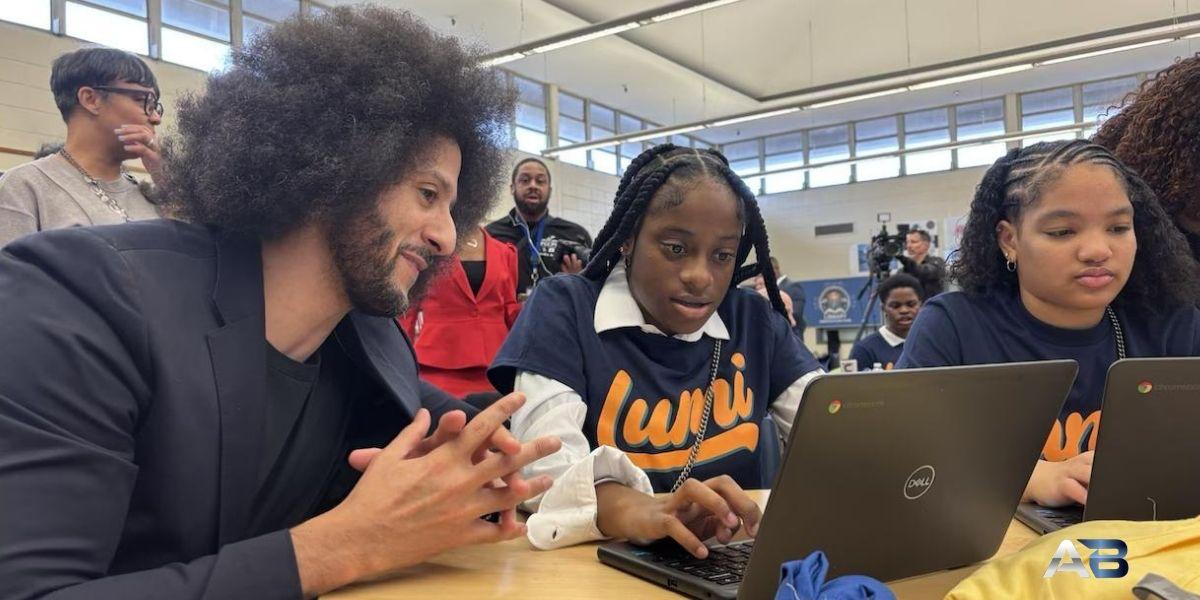
Colin Kaepernick, the former NFL quarterback who became a civil rights icon, is channeling his activism into education technology. His AI storytelling platform, Lumi Story AI, has launched as a pilot program in Prince George’s County Public Schools in Maryland, aiming to enhance student literacy while preparing diverse communities for careers in technology.
From Football Field to Classroom Innovation
The initiative represents a significant bet that early AI education can help address longstanding inequities in the tech industry. With over 90% of Prince George’s County students identifying as Black or Latino, groups historically underrepresented in technology careers, school officials view AI literacy as a pathway to economic opportunity and a matter of educational equity.
Kaepernick hasn’t played in the NFL since 2016, when he began kneeling during the national anthem to protest racial inequality and police violence against Black Americans. That protest effectively ended his professional football career, but Kaepernick has remained committed to social justice causes. Now he’s applying that same determination to education technology.
“We want to make sure [students] are prepared for the future,” Kaepernick said during a December demonstration at Largo High School. “We are dealing with a very dynamic landscape right now, where we are seeing industries change overnight. We also need to make sure that we are changing.”
Kaepernick maintains the discipline of his playing days, waking each morning to train as if he might return to professional football. He’s bringing that philosophy of constant readiness to his educational work, emphasizing that students need preparation for a rapidly evolving technological landscape.
How Lumi Story Works in Practice
The Lumi Story AI platform allows students to input their own creative writing and receive suggestions for improvement. The system helps visualize stories as graphic novels, combining traditional literacy skills with modern digital creation tools. Students in journalism and graphic arts classes across Prince George’s County Public Schools are currently using the platform for assignments.
The approach differs from AI tools that simply generate content on demand. Instead, Lumi Story emphasizes student creativity and original thinking, with AI serving as a collaborative partner in the creative process rather than a replacement for student work. This aligns with educational best practices around AI implementation, where technology supplements rather than supplants human learning.
Kaepernick frames AI education as essential for ensuring diverse representation in technology development. “We cannot just be consumers of the technology, we have to be builders of it,” he said. “We have to make sure that our communities are represented.”
That emphasis on community representation addresses a critical challenge in AI development. Current AI systems often reflect the biases and perspectives of their predominantly white and Asian male creators. Kaepernick argues that diversifying who builds AI systems can help create technology that better serves all communities.
District-Wide AI Integration Strategy
Prince George’s County isn’t approaching AI education haphazardly. In 2023, just one year after ChatGPT sparked widespread AI adoption, the district adopted a comprehensive three-year plan for teaching students to use the technology ethically and responsibly. The board of education followed up in 2024 with a policy explicitly stating that AI should supplement, not replace, classroom teachers.
The district is currently piloting eight different AI platforms across its schools. All middle and high schools have access to at least one AI program, ranging from general-purpose tools like Google’s Gemini to specialized curriculum platforms like Lumi Story.
Interim Superintendent Shawn Joseph said teacher training has been the primary focus of this year’s AI implementation efforts. The district plans to “dramatically expand” professional development opportunities centered on AI in the coming year.
“If teachers don’t model this, students will learn AI in isolation without ethics, without context or without reflection,” Joseph said. “To me, silence is not neutrality, it’s an abnegation. We have to seize the moment to make this a teaching opportunity.”
Joseph’s comments reflect growing recognition among educators that avoiding AI in classrooms isn’t a viable option. Students already have access to AI tools through their personal devices. The question isn’t whether they’ll use AI, but whether they’ll learn to use it thoughtfully and ethically.
Opt-Out Now, Universal Soon
Currently, families can opt out of AI pilot programs because they aren’t part of the core curriculum. However, Joseph indicated that by next year, every student and teacher will likely be expected to use AI as it becomes integrated into standard instructional practices.
Director of technology integration Kimberly Roberson said the district is working to educate parents and teachers about AI’s potential benefits. Curriculum developers are creating guidelines for appropriate AI use across different subjects and grade levels. The general principle, Roberson explained, is that AI won’t be used to replace cognitive skill development.
“AI is going to make a huge impact everywhere, not just in education,” Roberson said. The district views AI literacy as increasingly essential for student success, regardless of their eventual career paths.
Statewide Guidelines Still Developing
While Prince George’s County has moved aggressively on AI implementation, statewide guidance remains a work in progress. The Maryland Department of Education has released cybersecurity guidelines to help schools safely implement AI technology, but comprehensive classroom use guidelines are still being developed. The next wave of state-level guidance is expected in January, according to a department statement.
In the absence of detailed state directives, individual districts have been developing their own frameworks. This local approach allows for experimentation and customization but also creates potential inconsistencies in how students across Maryland experience AI education.
Equity as the Driving Force
Joseph framed AI education as fundamentally about equity. Students without access to AI education will be disadvantaged in a workforce increasingly shaped by artificial intelligence, he argued.
“If schools avoid teaching AI, only the privileged students in our country will learn to use it critically outside of school,” Joseph said. “But when we as teachers use AI responsibly in the classroom, we democratize access to power.”
This equity argument has particular resonance in Prince George’s County, where the student population is predominantly Black and Latino. Technology sector employment statistics show dramatic underrepresentation of these groups, particularly in technical roles like software engineering and AI development.
By introducing AI tools and concepts early, school officials hope to demystify the technology and encourage more students from underrepresented backgrounds to pursue technology careers. The approach assumes that familiarity breeds interest and competence, potentially creating a pipeline of diverse talent for the tech industry.
Broader Educational Implications
Prince George’s County’s comprehensive approach to AI education may serve as a model for other districts wrestling with similar questions. The combination of multiple platform pilots, extensive teacher training, clear policies about AI’s role relative to human instruction, and explicit focus on equity addresses many of the concerns educators have raised about AI in schools.
However, significant questions remain. How will districts measure whether AI tools actually improve learning outcomes? What happens to students whose families opt out as AI becomes more central to curriculum? How can schools ensure AI use doesn’t exacerbate existing achievement gaps?
These questions will likely take years to answer definitively. In the meantime, districts like Prince George’s County are betting that early adoption, combined with thoughtful implementation and strong ethical guardrails, will position their students for success in an AI-influenced future.
For Kaepernick, the work represents a continuation of his activism through different means. Just as he used his platform as an athlete to highlight social justice issues, he’s now using his platform as an entrepreneur to advocate for educational equity and diverse representation in technology. The former quarterback may no longer be on the field, but he’s still very much in the game.