
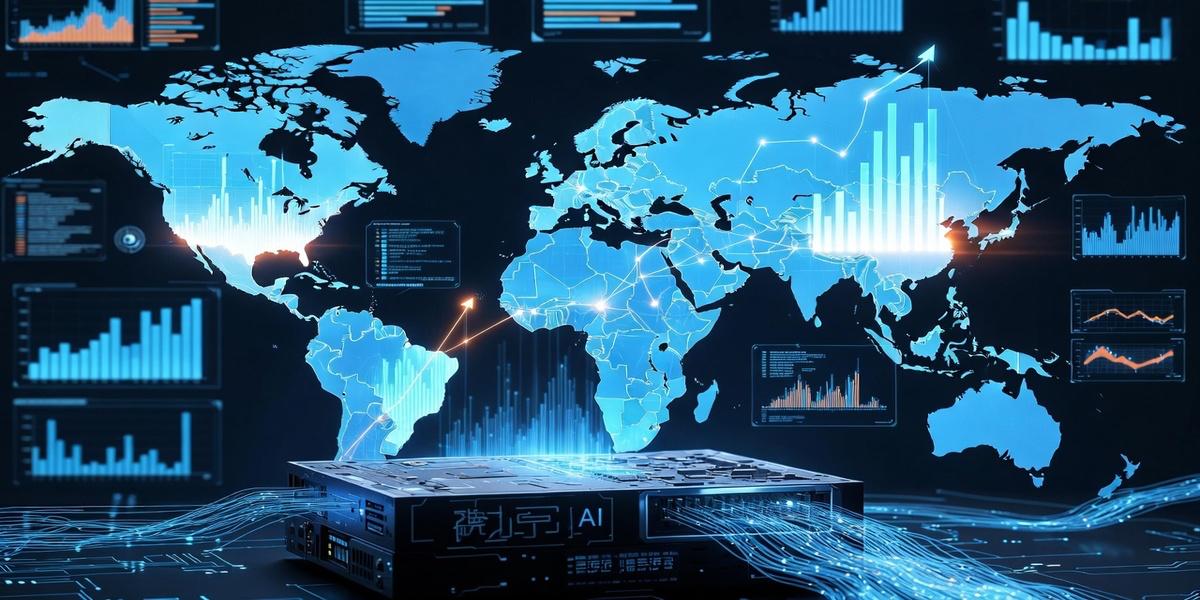
DeepSeek, a Chinese-developed artificial intelligence model, is rapidly gaining market share in developing countries, particularly across the Global South, according to a new Microsoft report.
The findings highlight shifting dynamics in the global AI competition as Chinese technology companies expand influence beyond their home market. While Western AI models from OpenAI, Google, and Anthropic dominate conversations in North America and Europe, DeepSeek has quietly built substantial presence in regions often overlooked by major tech companies. The model’s growth in developing nations raises questions about AI access, technological sovereignty, and the geopolitical implications of AI infrastructure controlled by different global powers.
DeepSeek’s Market Penetration Strategy
DeepSeek has gained traction in the Global South through several strategic advantages. Lower pricing compared to Western alternatives makes the technology accessible to organizations and governments with limited budgets. Many developing countries prioritize cost-effectiveness when adopting new technologies, creating opportunities for providers offering competitive pricing without requiring cutting-edge performance.
The model supports multiple languages prevalent in developing regions, addressing a significant gap in AI accessibility. While English-language models dominate the market, populations in Latin America, Africa, Southeast Asia, and South Asia require AI systems capable of processing their native languages effectively. DeepSeek’s multilingual capabilities reduce barriers to adoption in these markets.
Local partnerships and regional data centers improve service quality by reducing latency and addressing data sovereignty concerns. Countries increasingly scrutinize where AI training data is stored and processed, preferring solutions that keep sensitive information within national or regional boundaries. DeepSeek’s willingness to establish local infrastructure addresses these concerns more effectively than competitors relying solely on centralized cloud services.
Regional Adoption Patterns
Microsoft’s report indicates particularly strong DeepSeek adoption in Southeast Asia, Latin America, and parts of Africa. Government agencies, educational institutions, and businesses in these regions have integrated the AI model into various applications including customer service automation, document processing, and data analysis.
Southeast Asian countries have embraced DeepSeek for e-commerce, digital payment systems, and government services digitization. The region’s rapid digital transformation creates demand for AI tools that can scale quickly without prohibitive costs. DeepSeek’s integration with regional technology ecosystems facilitates adoption by companies already using Chinese-origin software and platforms.
Latin American organizations use DeepSeek primarily for Spanish and Portuguese language processing tasks. The model’s performance in these languages reportedly matches or exceeds alternatives in certain applications, making it attractive for customer service, content moderation, and administrative automation.
African adoption focuses on mobile-first applications and agricultural technology. DeepSeek’s ability to run on less powerful hardware suits regions where computational resources are limited. Agricultural applications using AI for crop disease detection, yield prediction, and market price forecasting benefit from models optimized for efficiency rather than maximum capability.
Competitive Dynamics and Market Implications
DeepSeek’s expansion challenges assumptions that Western AI companies would dominate global markets indefinitely. The success demonstrates that technological superiority alone doesn’t guarantee market leadership when factors like pricing, localization, and partnership strategies matter equally to customers.
Microsoft, despite reporting on DeepSeek’s growth, faces direct competition from the Chinese model in markets where its Azure AI services operate. The company’s interest in tracking DeepSeek’s expansion likely stems from strategic concerns about losing ground in fast-growing regions that represent future revenue opportunities.
OpenAI’s ChatGPT and Google’s Gemini maintain dominance in developed markets but face obstacles expanding to price-sensitive regions. Their premium positioning and focus on cutting-edge capabilities may not align with developing country priorities of affordability and practical utility over breakthrough performance.
Chinese tech companies have history succeeding in Global South markets through strategies Western companies often overlook. Huawei’s telecommunications equipment, TikTok’s social media platform, and various smartphone manufacturers have all gained substantial market share in developing regions despite facing restrictions in Western markets.
Geopolitical Considerations
DeepSeek’s growth raises questions about technological dependency and data sovereignty. Countries adopting Chinese AI infrastructure may become reliant on technology they don’t control, with implications for national security and economic independence. Data processed by DeepSeek potentially flows to servers under Chinese jurisdiction, subject to China’s data regulations and government access requirements.
Western governments have expressed concerns about Chinese technology companies’ relationships with Beijing. While specific evidence regarding DeepSeek’s government connections remains unclear, China’s national intelligence laws theoretically require companies to cooperate with state security agencies when requested. This creates uncertainty for organizations using Chinese AI models for sensitive applications.
Developing countries face difficult trade-offs between technological access and sovereignty concerns. Affordable AI tools can accelerate development, improve public services, and enhance economic competitiveness. However, dependence on foreign-controlled infrastructure creates vulnerabilities if access is restricted for political reasons or if data is misused.
Some nations pursue multi-vendor strategies, using different AI models for various applications to avoid single-provider dependency. This approach increases complexity and costs but reduces risks associated with relying entirely on any one company or country’s technology.
Technical Performance and Capabilities
Microsoft’s report likely includes performance benchmarks comparing DeepSeek to Western alternatives, though specific details weren’t disclosed publicly. Understanding the model’s technical capabilities helps explain its market success beyond pricing advantages.
DeepSeek reportedly performs well on standard language model benchmarks, though it may lag cutting-edge models like GPT-4 or Claude in certain advanced reasoning tasks. For many practical applications, however, the performance gap proves irrelevant. Customer service chatbots, document summarization, and basic data analysis don’t require state-of-the-art capabilities, making DeepSeek’s “good enough” performance combined with lower costs attractive.
The model’s efficiency optimizations allow deployment on less expensive hardware, reducing total cost of ownership beyond just licensing fees. Organizations can run DeepSeek on existing infrastructure rather than upgrading to GPU-intensive systems required by more demanding models.
Training data composition affects model performance across different languages and domains. DeepSeek’s training likely emphasized non-English languages and content relevant to developing country contexts, improving its utility in these markets compared to models trained primarily on English-language internet content.
Regulatory and Ethical Considerations
AI regulation remains underdeveloped in many countries where DeepSeek operates. The absence of strict oversight creates both opportunities and risks. Companies can deploy AI applications quickly without lengthy approval processes, but limited accountability raises concerns about bias, misinformation, and misuse.
DeepSeek’s content moderation policies and safety measures warrant scrutiny. Different cultural contexts require different approaches to handling sensitive content, hate speech, and misinformation. A model developed in China may implement content policies reflecting Chinese regulatory requirements and values that don’t align with local norms in other countries.
Transparency about training data, model architecture, and decision-making processes varies significantly across AI providers. Western companies increasingly face pressure to disclose these details, though compliance remains incomplete. Chinese companies typically provide less transparency, making it difficult for users to understand potential biases or limitations.
Economic Impact on Developing Nations
AI adoption can accelerate economic development by improving productivity, enabling new business models, and enhancing public services. DeepSeek’s affordability potentially democratizes AI access, allowing smaller organizations and resource-constrained governments to benefit from automation and intelligent systems.
Job displacement concerns affect developing countries differently than developed nations. While automation threatens certain employment categories, many developing economies have large informal sectors and labor markets where AI adoption proceeds more slowly. The technology might eliminate some jobs while creating demand for new skills in AI implementation and maintenance.
Educational applications represent significant opportunity areas. AI tutoring systems, automated grading, and personalized learning platforms could improve educational outcomes in regions with teacher shortages or limited access to quality instruction. DeepSeek’s lower costs make these applications more financially viable for school systems with constrained budgets.
Healthcare applications including preliminary diagnosis assistance, medical records management, and drug interaction checking could extend limited healthcare resources further. AI models don’t replace physicians but can help them serve more patients more efficiently, particularly valuable in underserved regions.
Future Outlook and Strategic Implications
DeepSeek’s trajectory in the Global South will influence broader AI market dynamics and geopolitical competition. If Chinese AI companies successfully establish dominant positions in developing countries, they create economic dependencies while denying market share to Western competitors in regions representing future growth.
Western companies and governments must decide whether to compete more aggressively on price and localization or accept reduced presence in price-sensitive markets. Microsoft, Google, and OpenAI have resources to subsidize expansion in developing countries if they prioritize strategic positioning over short-term profitability.
Developing countries might pursue strategies supporting domestic AI development to reduce foreign dependency altogether. India, Brazil, and several other nations have announced initiatives to build indigenous AI capabilities, though success remains uncertain given the substantial resources required.
International cooperation on AI governance could address concerns about different regulatory approaches and data practices. However, geopolitical tensions between the US and China complicate efforts to establish global AI standards that all major players would follow.
The Microsoft report documenting DeepSeek’s expansion serves multiple purposes. It informs strategic decision-making within Microsoft about competitive responses. It raises awareness among policymakers about shifting technological influence. It potentially supports arguments for greater investment in making Western AI technologies accessible to developing countries.
As artificial intelligence becomes increasingly central to economic competitiveness and national security, the question of which countries and companies control AI infrastructure in different regions carries profound implications. DeepSeek’s quiet success in the Global South demonstrates that technological competition extends beyond performance benchmarks to include pricing, partnerships, and understanding diverse market needs across the developing world.