

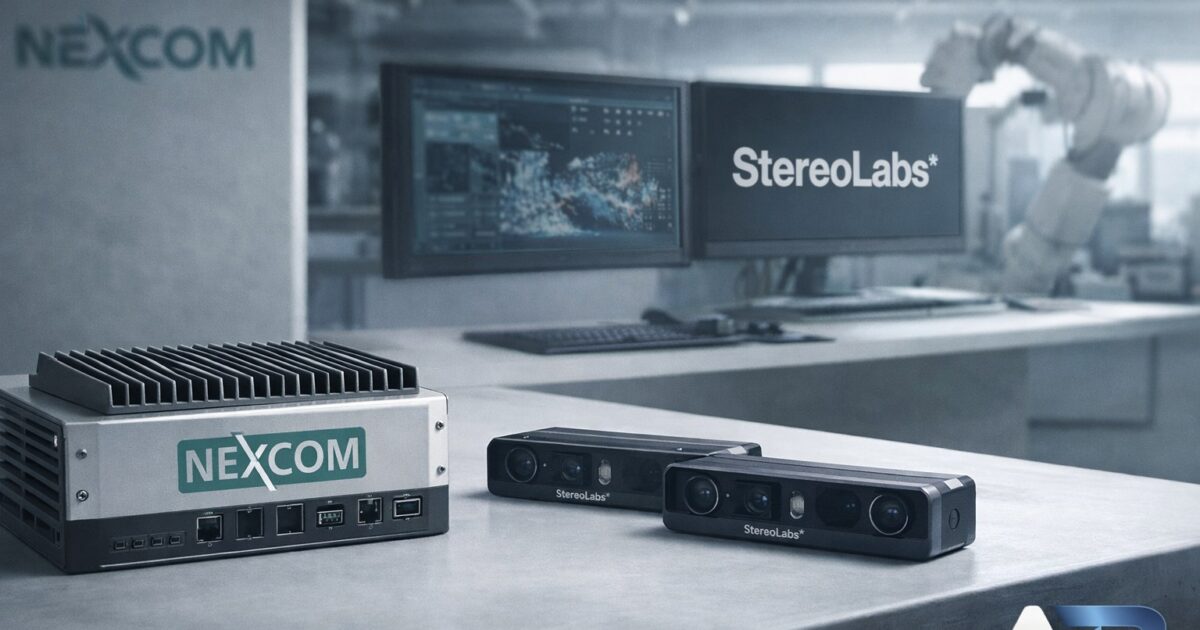
NEXCOM and Stereolabs have announced a strategic partnership aimed at accelerating the deployment of advanced imaging and 3D perception solutions across industrial and edge environments.
The collaboration brings together NEXCOM’s industrial grade computing platforms with Stereolabs’ depth sensing camera technology, targeting applications that require reliable real-time spatial awareness.
Combining Industrial Hardware With Depth Perception
Under the partnership, Stereolabs’ stereo vision cameras will be integrated with NEXCOM’s embedded and edge computing systems. This combination is designed to support use cases such as robotics, autonomous navigation, smart manufacturing, and intelligent inspection.
By aligning hardware level reliability with precise depth perception, the two companies aim to deliver solutions that can operate consistently in demanding real world conditions.
Focus on Edge and Real Time Applications
The joint offering is positioned for environments where low latency and on device processing are critical. Instead of relying heavily on cloud based pipelines, the integrated systems allow data to be processed closer to where it is generated.
This approach is particularly relevant for industrial automation and mobile platforms, where real time decision-making and operational stability are essential.
Expanding Ecosystem Reach
For NEXCOM, the partnership strengthens its ecosystem of vision enabled edge solutions. For Stereolabs, it provides access to industrial customers seeking production-ready platforms rather than experimental setups.
Both companies emphasized interoperability and scalability as key goals, enabling developers and system integrators to adapt the solutions to a wide range of deployment scenarios.
Industry Context
The collaboration reflects a broader trend toward combining specialized sensing technologies with robust edge hardware to support next generation industrial systems. As demand grows for smarter machines and spatially aware devices, partnerships like this are becoming increasingly common.