

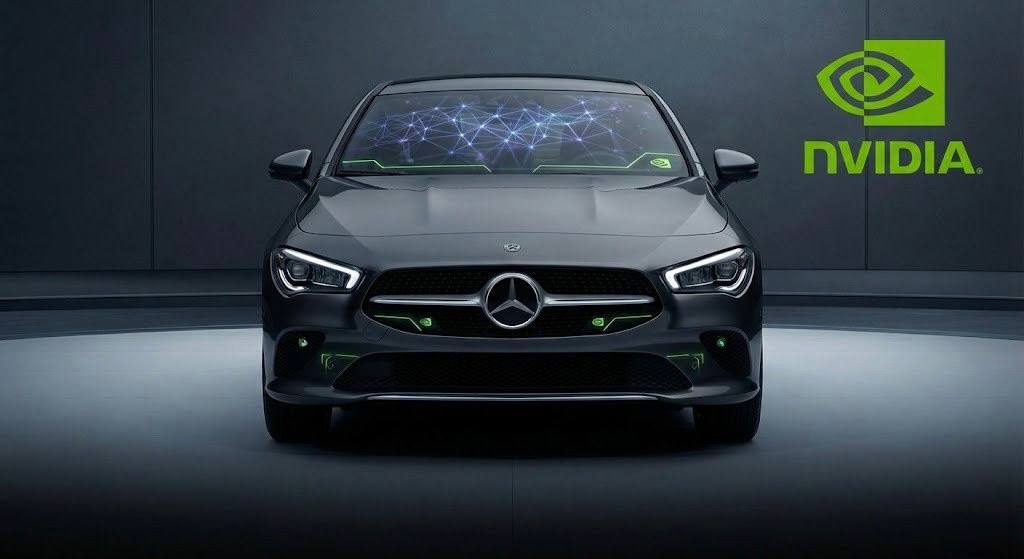
Nvidia has confirmed its new autonomous driving software will launch in a production vehicle by the end of 2026. Mercedes-Benz’s new CLA four-door coupé becomes the first car to debut this technology.
The German automaker will implement Nvidia Drive AV, an AI-based system delivering Level 2 point-to-point driver assistance. This automation level means the car controls steering, braking, and acceleration while drivers remain ready to intervene.
Alpamayo: A New Approach to Autonomous Driving
The Nvidia product represents the first implementation of Alpamayo, a new family of open source models. These models specifically target long-tail autonomous driving challenges.
Edge cases have traditionally proven problematic for autonomous driving software. Alpamayo addresses these unusual scenarios through advanced reasoning capabilities.
Nvidia CEO Jensen Huang unveiled Alpamayo at CES 2026 in Las Vegas. He described the announcement as a pivotal moment for physical AI development.
Huang stated that machines can now understand, reason, and act in the real world. Alpamayo brings reasoning capabilities to autonomous vehicles for safer navigation in complex environments.
Technical Components Released
Several key Alpamayo components were released at the consumer electronics show. Alpamayo 1 features 10 billion parameters as a vision-language-action model.
The model uses chain of thought reasoning to plot navigation paths. It shows reasoning for each decision, which interests regulators investigating AV incidents.
Nvidia also released AlpaSim, a full open-source end-to-end simulation framework. Developers can use it to create and test autonomous vehicle systems.
More than 1,700 hours of physical AI open data sets accompany the release. The open source approach has attracted interest from multiple automotive companies.
Industry Partners Join the Platform
Automakers JLR and Lucid have expressed interest in the technology. Uber is also exploring Alpamayo for building reasoning stacks toward Level 4 automation.
Level 4 represents full autonomy in specific circumstances without human intervention. Current implementations typically remain at Level 2 or Level 3 capabilities.
Mercedes already offers Level 3 DrivePilot technology enabling hands-off, eyes-off driving in certain conditions. The new Nvidia system adds complementary capabilities.
Safety Architecture
Nvidia’s Drive AV solution incorporates the Nvidia Halos safety system. This architecture adds redundancy and safety guardrails throughout the driving experience.
Point-to-point navigation in complex urban environments represents a key feature. The system also provides proactive collision avoidance and automated parking in tight spaces.
Ali Kani, Nvidia’s vice president of automotive, emphasized the programmable nature of the technology. Vehicles become updatable and perpetually improving through data and software updates.
Timeline and Future Development
The first Mercedes CLA models using Nvidia technology arrive by the end of 2026. This marks a significant milestone for production autonomous driving systems.
The open source nature of Alpamayo encourages broader industry adoption. Multiple automakers can build upon the foundation for their own implementations.
Nvidia positions itself as the intelligence backbone for the automotive industry. The company continues expanding its physical AI capabilities across multiple sectors.
The collaboration demonstrates accelerating progress toward safer autonomous vehicles. Edge case handling through AI reasoning represents a major advancement in the field.