

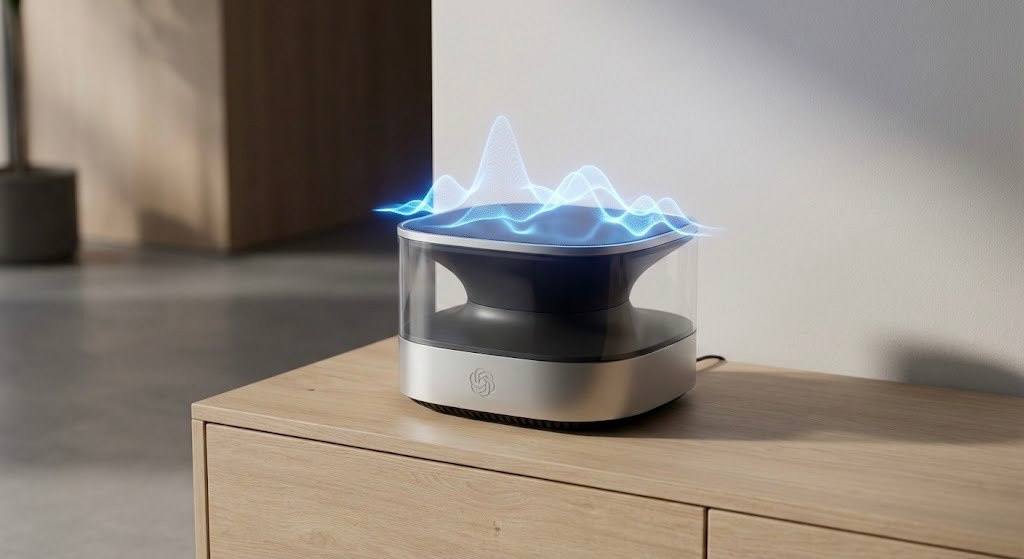
OpenAI is accelerating its audio AI development ahead of a planned hardware device launch. The company has merged several internal teams over the past two months. The goal is to close the gap between audio and text model performance.
The Audio Accuracy Problem
OpenAI’s audio models currently lag behind text-based counterparts. Current and former employees confirm accuracy and response speed remain significant challenges. The new architecture aims to address these limitations directly.
The updated audio model will deliver more natural and emotional speech. It will provide more accurate answers in real-time conversations. Users will be able to speak simultaneously with the AI without awkward pauses.
Q1 2026 Release Target
OpenAI targets a first quarter 2026 release for the new audio model. Kundan Kumar leads the effort. He joined OpenAI from Character.AI, where he headed audio development.
Kumar brings impressive credentials to the role. He co-founded Lyrebird AI, a voice cloning startup acquired by Descript in 2019. He completed his PhD research at MILA under Yoshua Bengio. His expertise spans neural audio generation and speech synthesis.
Hardware Plans Take Shape
The audio improvements feed directly into OpenAI’s hardware ambitions. The company is developing multiple device prototypes. These include a screenless smart speaker, AR glasses, a voice recorder, and a wearable pin.
The flagship product appears to be a pocket-sized speaker without a display. It will rely primarily on voice interaction. This approach challenges the screen-centric smartphone paradigm.
Internal documents refer to one device as “Gumdrop.” Manufacturing discussions initially focused on Luxshare, a major Apple supplier. A dispute over production locations shifted talks to Foxconn facilities in Vietnam.
Jony Ive Partnership
OpenAI acquired io Products for $6.5 billion in May 2025. The startup was co-founded by legendary Apple designer Jony Ive. He now leads design efforts across both companies.
The acquisition brought more than design expertise. Over 24 former Apple engineers joined OpenAI throughout 2025. They specialize in user interfaces, cameras, audio, wearables, and manufacturing.
Tang Tan serves as OpenAI’s Chief Hardware Officer. The 25-year Apple veteran previously reported to hardware chief John Ternus. His team has secured partnerships with Luxshare and Goertek for component supply.
The “Super AI Assistant” Vision
OpenAI’s ChatGPT already competes fiercely with rivals like Claude. The hardware push aims to extend this dominance into physical devices. Sam Altman has described the initiative as creating a “super AI assistant.” The device would become as central to daily life as smartphones. It would fit in pockets or sit on desks for easy access.
Altman set an ambitious target of shipping 100 million devices. He claimed this would happen “faster than any company has ever shipped 100 million of something new before.” The timeline stretches from late 2026 to early 2027.
Privacy Concerns Loom
Always-listening devices face significant privacy challenges. Users and regulators worry about continuous audio monitoring. OpenAI must navigate these concerns carefully to achieve mainstream adoption.
The company will need clear indicators when recording occurs. Local processing for basic queries could help preserve privacy. Transparent data handling policies will be essential for consumer trust.
Market Competition
OpenAI enters a crowded smart speaker market. Amazon, Google, and Apple already have tens of millions of devices in homes. Previous AI-first hardware like Rabbit R1 and Humane AI Pin faced harsh criticism.
The differentiator must be capability density. OpenAI’s language models could deliver experiences impossible with current voice assistants. Success depends on combining world-class AI with thoughtful industrial design.
Voice AI investment reached $6.6 billion in 2025. The market is expected to triple to $34 billion by 2030. OpenAI is betting heavily on this audio-first future.