

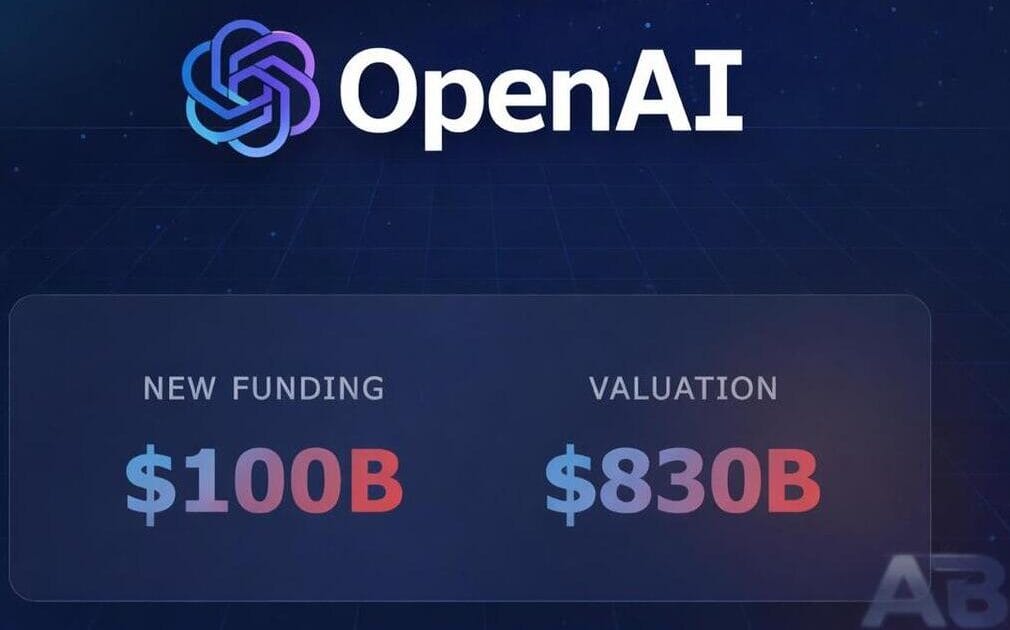
The creator of ChatGPT has entered preliminary discussions to secure as much as $100 billion in fresh capital, a move that could push the company’s valuation to approximately $830 billion, according to sources familiar with the negotiations. This represents one of the most ambitious fundraising efforts in technology history.
The San Francisco-based company aims to finalize this capital injection by the conclusion of the first quarter in 2026, with sovereign wealth funds expected to participate as major investors. The contemplated valuation reflects a dramatic surge from earlier this week when discussions centered around a $750 billion figure, and marks a substantial 66 percent increase from the $500 billion assessment established during an October secondary share transaction.
Financial Muscle Behind Innovation
The organization currently maintains reserves exceeding $64 billion, yet the aggressive fundraising strategy underscores the extraordinary capital requirements of maintaining leadership in machine learning development. The company’s operational costs have expanded beyond what traditional cloud partnerships and service credits can accommodate, particularly as computing expenses for model inference continue to escalate.
Current annual revenue stands at roughly $20 billion on a run-rate basis, demonstrating strong commercial traction for the company’s products. However, CEO Sam Altman must convince institutional investors that sustained returns from scaling models can justify positioning the firm among the world’s most valuable entities, rivaling established technology giants.
SoftBank’s Sprint to the Finish Line
Meanwhile, Japanese investment powerhouse SoftBank Group finds itself in a high-stakes race against time. The conglomerate is working aggressively to complete a $22.5 billion funding pledge to the machine learning firm by December 31, employing various cash-raising mechanisms to meet the deadline.
CEO Masayoshi Son has already divested SoftBank’s complete $5.8 billion position in chip manufacturer Nvidia, liquidated $4.8 billion of T-Mobile US holdings, and implemented staff reductions to generate the necessary liquidity. The executive has essentially halted most other dealmaking activities at SoftBank’s Vision Fund, with transactions exceeding $50 million now requiring his personal authorization.
The Japanese firm’s commitment stems from an April agreement to invest up to $30 billion in the machine learning company, with $10 billion delivered immediately. The remaining balance was contingent upon the startup’s transition to a for-profit corporate structure by year-end, a condition successfully fulfilled in October.
SoftBank’s motivation extends beyond the immediate investment. The firm secured its deal at a $300 billion valuation in April, and with valuations potentially approaching $900 billion, the conglomerate stands to realize substantial paper gains upon transaction completion.
Strategic Maneuvering for Capital
To assemble the required funds, SoftBank may tap into approximately $11.5 billion of unused margin loan capacity secured against its ownership stake in semiconductor designer Arm Holdings. The company recently expanded this borrowing capacity by $6.5 billion, benefiting from Arm’s stock performance, which has tripled since its initial public offering.
The Japanese conglomerate is also exploring liquidation of holdings in Chinese ride-hailing platform Didi Global, which plans to relist in Hong Kong following a regulatory dispute that forced its U.S. delisting in 2021. Additionally, the anticipated public offering of SoftBank’s payment application PayPay, originally scheduled for this month but postponed, is now expected during the first quarter of next year and could generate more than $20 billion.
Industry Context and Market Dynamics
Both organizations participate in Stargate, a $500 billion initiative focused on constructing data centers for machine learning training and inference operations. The project represents a cornerstone of governmental strategy to maintain technological competitiveness.
The unprecedented capital requirements reflect broader industry trends, with major technology companies committing massive resources to data center infrastructure. Meta Platforms and other tech giants have announced extraordinary buildout expenditures, bringing partners aboard to distribute financial exposure.
These substantial capital commitments have prompted market observers to question potential returns on investment, with some analysts raising concerns about an overheated sector that could experience correction if projected revenues fail to materialize.
Looking Forward
The success of this fundraising initiative will serve as a critical barometer for investor confidence in advanced machine learning technology. While enthusiasm for the sector remains robust, the sheer scale of capital required and the elevated valuations being discussed, present questions about long-term sustainability.
For SoftBank, completing the year-end commitment represents more than financial obligation fulfillment. It positions the firm as a central player in what CEO Masayoshi Son views as the defining technological transformation of the coming decades, despite the considerable financial gymnastics required to make it happen.
Terms for the new funding round remain flexible, and it’s uncertain whether sufficient investor demand exists to meet the ambitious $100 billion target. Nevertheless, the discussions themselves signal the extraordinary sums being mobilized as competition intensifies in the race to develop increasingly capable machine learning systems.