

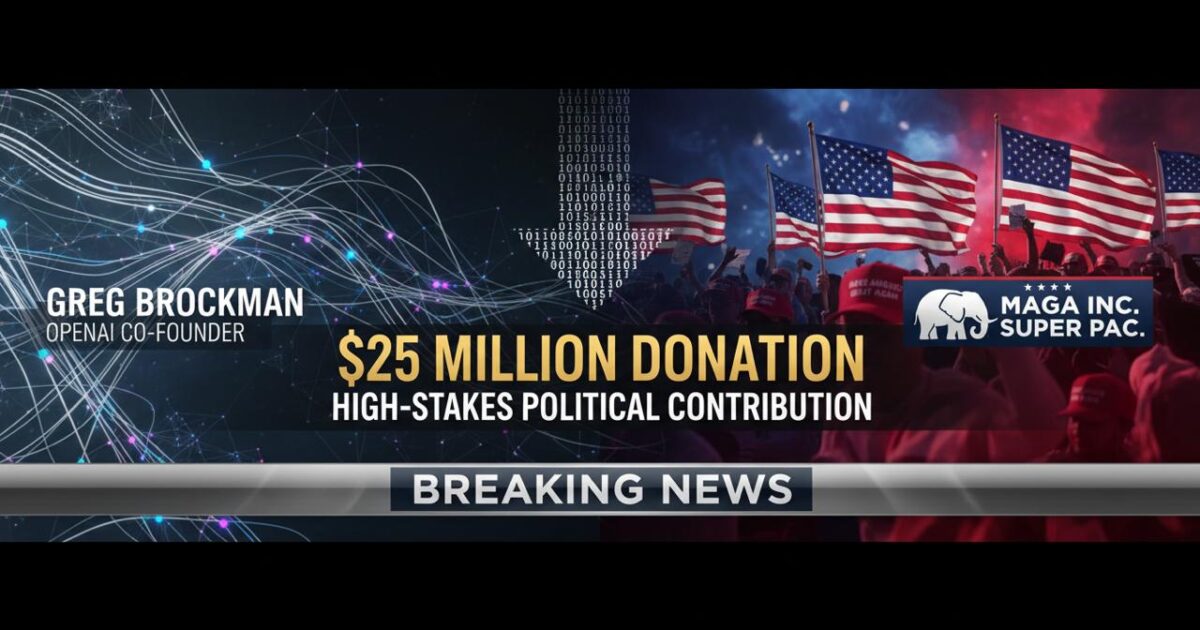
Greg Brockman, co-founder and president of OpenAI, has made a $25 million contribution to MAGA Inc., Donald Trump’s super PAC, according to Federal Election Commission filings reported by Bloomberg. The substantial donation positions Brockman among the organization’s top contributors and highlights the deepening political engagement of artificial intelligence industry leaders as regulatory debates intensify.
Super PAC Raises $102 Million in Six Months
The contribution represents one of the largest individual donations to Trump’s political operation and signals a strategic calculation by a key figure in the AI industry. While Brockman hasn’t publicly explained his support for Trump, the timing and scale of the donation suggest the AI sector’s growing interest in shaping federal policy approaches to technology regulation.
MAGA Inc. collected $102 million during the second half of 2025, bringing its total war chest to $294 million by year’s end. Three donors accounted for more than half of the fundraising haul: Brockman’s $25 million, a $20 million contribution from cryptocurrency exchange Crypto.com, and $11 million from private equity investor Konstantin Sokolov.
The concentration of funding from technology and cryptocurrency sectors reflects these industries’ particular interest in the Trump administration’s regulatory approach. Both AI and crypto have faced increasing scrutiny from regulators, making federal policy direction a high-stakes concern for major players.
Super PACs, which can raise unlimited funds from individuals and corporations, have become central to modern presidential campaign infrastructure. MAGA Inc.’s substantial funding provides the Trump political operation with resources for advertising, voter outreach, and organizational activities as the 2026 midterm elections approach and the 2028 presidential cycle begins taking shape.
AI Industry’s Regulatory Stakes
Brockman and OpenAI stand to benefit significantly from the Trump administration’s promised approach to AI regulation. The administration has emphasized federal-level oversight rather than allowing individual states to develop their own AI regulatory frameworks, a preference that aligns closely with industry priorities.
Patchwork state regulations create compliance complexity and operational uncertainty for companies operating nationally. A unified federal framework, particularly one described as “minimally burdensome,” would reduce regulatory overhead and potentially allow faster deployment of AI products and services.
Trump issued an executive order in December calling for streamlined national AI policy and limiting state-level regulation, though the order lacks the constitutional authority to preempt state laws without congressional legislation. Nevertheless, the administration’s stated direction signals a regulatory environment more favorable to rapid AI development than alternatives that might have emerged under different political leadership.
Access and Influence Through Political Contributions
Beyond specific regulatory outcomes, large political donations typically provide donors with access to administration officials and opportunities to shape policy discussions. For Brockman and OpenAI, a $25 million contribution could translate to meaningful influence over how federal AI policy develops.
The AI industry faces numerous regulatory questions that will be resolved over coming years, including issues around copyright and training data, liability for AI-generated content, transparency requirements, safety standards, and export controls related to advanced AI systems. Having direct channels to administration decision-makers could prove valuable as these policies take shape.
Political contributions of this magnitude generally reflect calculations that the investment will yield returns through favorable policy outcomes or protected business interests. While Brockman hasn’t publicly commented on his donation, the strategic logic seems apparent given OpenAI’s regulatory exposure and growth ambitions.
“Leading the Future” and Legislative Pushback
Brockman’s political activity extends beyond campaign contributions. He’s also a member of “Leading the Future,” a political network advocating against stricter AI legislation. This involvement suggests a coordinated approach to shaping the regulatory environment through multiple channels: direct political support, industry advocacy groups, and public policy engagement.
“Leading the Future” represents one of several industry-backed efforts to influence AI policy debates. These organizations typically argue that excessive regulation will stifle innovation, push AI development to countries with lighter regulatory touches, and prevent the United States from maintaining technological leadership.
Critics counter that voluntary industry commitments and light-touch regulation are insufficient given AI’s potential societal impacts, from labor displacement to privacy concerns to risks from increasingly capable systems. The regulatory debate reflects fundamental disagreements about whether innovation or caution should take priority when technologies carry significant uncertainties.
Crypto and Tech Converge on Trump Support
The composition of MAGA Inc.’s donor base reveals which industries view the Trump administration as particularly aligned with their interests. Alongside Brockman’s AI-focused contribution, Crypto.com’s $20 million donation reflects the cryptocurrency sector’s enthusiasm for Trump’s crypto-friendly rhetoric and promises of lighter regulation.
Both AI and cryptocurrency represent cutting-edge technology sectors that have faced regulatory uncertainty and, in crypto’s case, active enforcement actions from agencies like the Securities and Exchange Commission. The Trump administration’s general deregulatory orientation and specific statements about technology policy have made it an attractive political bet for these industries.
This convergence suggests that technology sector political engagement is becoming more explicitly transactional, with companies and executives directing substantial resources toward candidates and parties perceived as offering the most favorable regulatory environments rather than primarily considering traditional political factors.
OpenAI’s Complex Political Position
Brockman’s donation creates potential complications for OpenAI’s public positioning. The company has generally avoided overt partisan political stances, instead emphasizing its mission to ensure artificial general intelligence benefits humanity broadly. A $25 million contribution to a partisan super PAC from a co-founder and president could complicate that narrative.
OpenAI has faced criticism from various political perspectives: some progressives worry about concentration of AI power in private companies and potential labor displacement, while some conservatives express concerns about content moderation and perceived political bias in AI systems. Maintaining relationships across the political spectrum becomes more challenging when senior leadership makes highly visible partisan contributions.
However, the company may calculate that regulatory benefits from a favorable administration outweigh potential reputational costs. As AI regulation becomes increasingly politicized, remaining completely neutral may not be viable for major players with substantial stakes in policy outcomes.
The Broader Pattern of Tech Political Engagement
Brockman’s donation fits within a broader pattern of technology executives increasing political engagement as their industries face growing regulatory scrutiny. Leaders from companies including Meta, Google, and various cryptocurrency firms have made substantial political contributions and hired extensive lobbying operations as technology policy moves to the center of legislative and regulatory agendas.
This trend reflects technology’s transition from a relatively lightly regulated sector to one facing active policy debates on multiple fronts: antitrust enforcement, content moderation, data privacy, AI safety, cryptocurrency regulation, and more. As regulatory stakes increase, political engagement naturally intensifies.
The question facing technology companies is whether political contributions and lobbying can effectively shape regulatory outcomes or whether public pressure, congressional action, and regulatory agency independence will drive policy regardless of industry preferences. The coming years will test whether Brockman’s $25 million investment yields the regulatory environment OpenAI seeks.
What This Means for AI Policy
Large political contributions from AI industry leaders signal that regulatory debates won’t be resolved purely on technical or public interest grounds. Economic interests, political calculations, and industry lobbying will significantly influence how AI governance develops.
For those concerned about AI risks or advocating for stronger safety requirements, Brockman’s donation illustrates the resources backing lighter-touch approaches. Industry has substantial financial capacity to support political allies and fund advocacy efforts resisting stricter regulation.
Conversely, from industry perspectives, political engagement represents necessary participation in policy processes that will determine whether companies can operate with reasonable regulatory clarity or face unpredictable patchworks of conflicting requirements.
As AI capabilities continue advancing and deployment accelerates, the regulatory framework governing this technology will have profound implications for innovation, safety, competition, and societal impacts. Brockman’s $25 million contribution represents a significant bet on which political direction will best serve OpenAI’s interests in shaping that framework.