

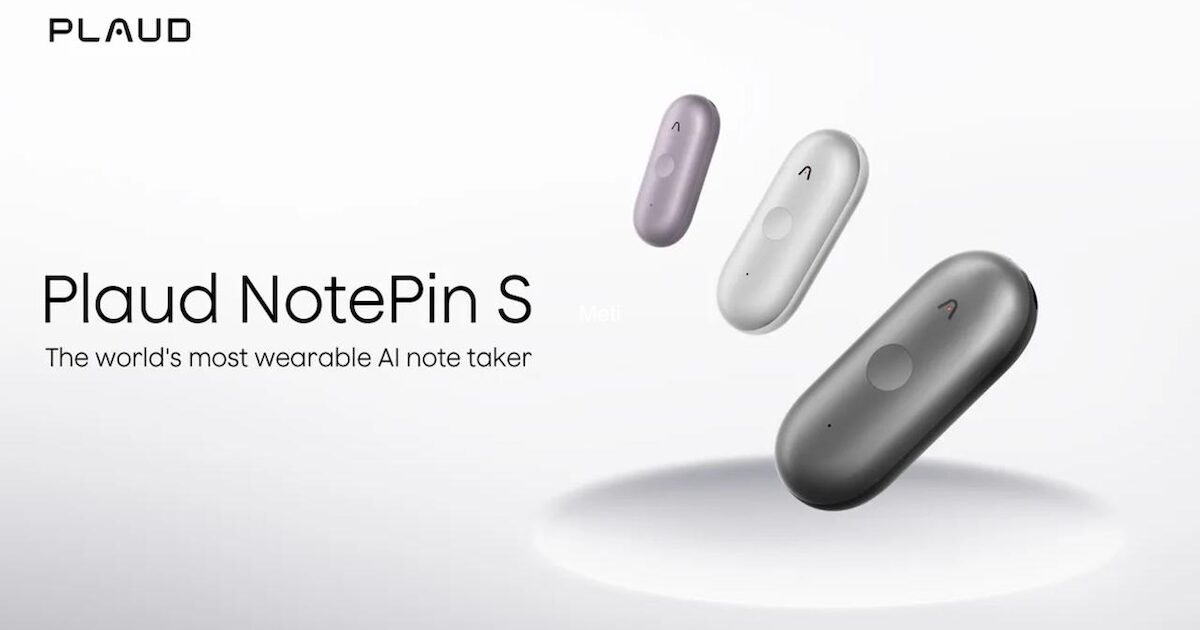
Plaud.ai has introduced two new products at the Consumer Electronics Show that could reshape how professionals capture and process meeting notes. The company unveiled the Plaud NotePin S, an upgraded AI-powered wearable recorder, alongside Plaud Desktop, a native meeting recording application that operates without sending bots into online conferences. The launches position Plaud as a serious challenger to established players like Otter.ai in the competitive AI transcription market.
NotePin S: Refined Design, Enhanced Functionality
Since the generative AI boom began, AI-powered wearables have gained significant traction among professionals seeking seamless ways to document conversations and meetings. Plaud has emerged as a pioneer in this space, and the company’s latest offerings demonstrate its commitment to refining the AI note-taking experience across both physical and digital environments.
The Plaud NotePin S maintains the minimalist aesthetic that defined its predecessor while incorporating meaningful improvements. The device retains its sleek, elongated pill-shaped design that can be worn as a bracelet, necklace, brooch, or clip, providing constant access to recording capabilities without drawing attention.
The most significant upgrade comes in the form of an instant highlight button, previously available only on Plaud’s credit card-shaped devices, the Plaud Note Pro and Plaud Note. Users can tap this button during recordings to signal the AI about particularly important moments, helping the system understand which portions of conversations deserve special attention in generated summaries.
According to the company’s announcement at CES 2026, the new model delivers “more seamless recording” compared to the original NotePin. While Plaud hasn’t detailed specific technical improvements, the emphasis on reduced friction suggests refinements to microphone sensitivity, processing speed, or battery performance.
The device’s wearable form factor addresses a fundamental challenge in professional note-taking: capturing important information without disrupting natural conversation flow. By eliminating the need to hold recording devices or type notes during meetings, the NotePin S allows users to maintain eye contact and engage more authentically with conversation partners.
Pricing and Subscription Model
The Plaud NotePin S carries a retail price of $179, representing a $20 increase over the original NotePin. This pricing includes a free starter plan that provides basic recording and transcription capabilities. Users requiring additional recording minutes or access to advanced AI features can upgrade to paid subscription tiers.
This pricing strategy positions the NotePin S competitively against other AI transcription services while attempting to monetize ongoing usage through subscriptions. The model mirrors approaches from competitors like Otter.ai and Fireflies.ai, which offer free tiers with limitations and paid plans for power users.
For professionals who attend numerous meetings daily, subscription costs can accumulate quickly across multiple services. Plaud’s pricing will need to demonstrate clear value propositions, whether through superior transcription accuracy, better AI insights, or more convenient user experiences, to justify the investment relative to established alternatives.
Plaud Desktop: Bot-Free Meeting Recording
Perhaps more significant than the hardware refresh is Plaud’s entry into desktop meeting recording with Plaud Desktop. The application tackles online meetings, which now occur as frequently as in-person gatherings for many professionals, but does so with a distinctly different approach than competitors.
Unlike Otter.ai or Fireflies.ai, which join video conferences as visible bot participants, Plaud Desktop operates as a native recording experience without sending automated attendees into meetings. The application detects when online meetings occur on platforms including Zoom, Google Meet, and Microsoft Teams, then enables users to initiate “secure, real-time audio recording.”
This bot-free approach addresses a common friction point with existing meeting recording tools. Many professionals report that visible recording bots make meeting participants uncomfortable, potentially changing conversation dynamics or causing some attendees to disengage. Some organizations prohibit bot-based recording tools entirely due to security or privacy concerns.
By recording locally rather than requiring bot participation, Plaud Desktop potentially sidesteps these objections while still capturing meeting content for transcription and AI analysis. However, this approach still requires users to inform meeting participants about recording, as legal and ethical requirements around consent remain regardless of the technical recording method.
Multimodal Input Capabilities
Plaud Desktop incorporates multimodal input options, allowing users to supplement audio recordings with additional context including images and text. This capability recognizes that modern meetings often involve screen sharing, presentation slides, and collaborative documents that provide important context for understanding discussions.
By capturing these additional inputs alongside audio, Plaud Desktop can theoretically provide richer summaries and more accurate insights than audio-only transcription. The AI can reference specific slides or documents when explaining meeting outcomes, creating more useful artifacts for later review.
This multimodal approach aligns with broader trends in AI development, where systems increasingly process multiple information types simultaneously rather than focusing narrowly on single modalities like text or audio alone.
Unified Ecosystem Across Devices
Plaud is positioning its various products as an integrated ecosystem rather than standalone tools. All recordings made through either the NotePin S wearable or Plaud Desktop application can be accessed through centralized platforms including Plaud Desktop, the Plaud mobile app, and Plaud Web.
This cross-platform accessibility addresses a practical challenge professionals face when using multiple recording tools: scattered notes across different applications that don’t communicate with each other. By unifying access points, Plaud allows users to review any recording from any device, reducing friction when searching for specific meeting information.
The ecosystem approach also creates potential lock-in effects. Once professionals commit to Plaud’s platform and accumulate substantial recording libraries, switching to competitors becomes more difficult due to the effort required to migrate or abandon existing content.
Competitive Landscape and Market Position
Plaud enters an increasingly crowded market for AI-powered meeting tools. Otter.ai has established strong brand recognition and substantial user bases, particularly among journalists, students, and business professionals. Fireflies.ai has carved out market share with integrations across numerous platforms and competitive pricing.
Additionally, major technology companies are incorporating meeting transcription into their core products. Microsoft Teams includes built-in transcription, as does Google Meet for certain account types. Zoom offers similar capabilities. These integrated solutions benefit from seamless user experiences within platforms professionals already use daily.
Plaud’s differentiation strategy appears to focus on hardware wearables for in-person meetings and bot-free recording for online gatherings. Whether these distinctions prove compelling enough to capture market share from established competitors remains uncertain.
Privacy and Security Considerations
AI-powered recording tools inherently raise privacy questions that Plaud will need to address comprehensively. Recording conversations, whether in-person or online, creates data that could be misused if security measures prove inadequate or if company policies don’t sufficiently protect user information.
Plaud emphasizes “secure, real-time audio recording” in its marketing materials but hasn’t publicly detailed specific security architectures, data retention policies, or encryption methods. As the company grows and attracts more users, particularly from enterprises with strict compliance requirements, transparent privacy practices will become increasingly important.
The bot-free approach of Plaud Desktop may actually complicate privacy compliance in some ways. While it avoids the visibility of bot participants, it also potentially makes it easier for users to record meetings without clear disclosure to other participants, creating ethical and legal risks.
Looking Ahead
ZDNET indicated it would test the NotePin S firsthand and provide updated impressions, suggesting that hands-on reviews will help clarify whether Plaud’s latest hardware delivers meaningful improvements over its predecessor. Early adopter feedback will be crucial in determining market reception.
For Plaud to successfully challenge established players like Otter.ai, the company will need to demonstrate clear advantages in transcription accuracy, AI insight quality, user experience, or pricing. Marginal improvements likely won’t justify switching costs for professionals already comfortable with existing tools.
The company’s dual focus on wearable hardware and desktop software suggests Plaud is betting that comprehensive coverage across meeting types, in-person and online, will prove attractive to users tired of juggling multiple recording solutions. Whether this integrated approach resonates with the market will become clearer as the products reach broader audiences and accumulate user reviews throughout 2026.