

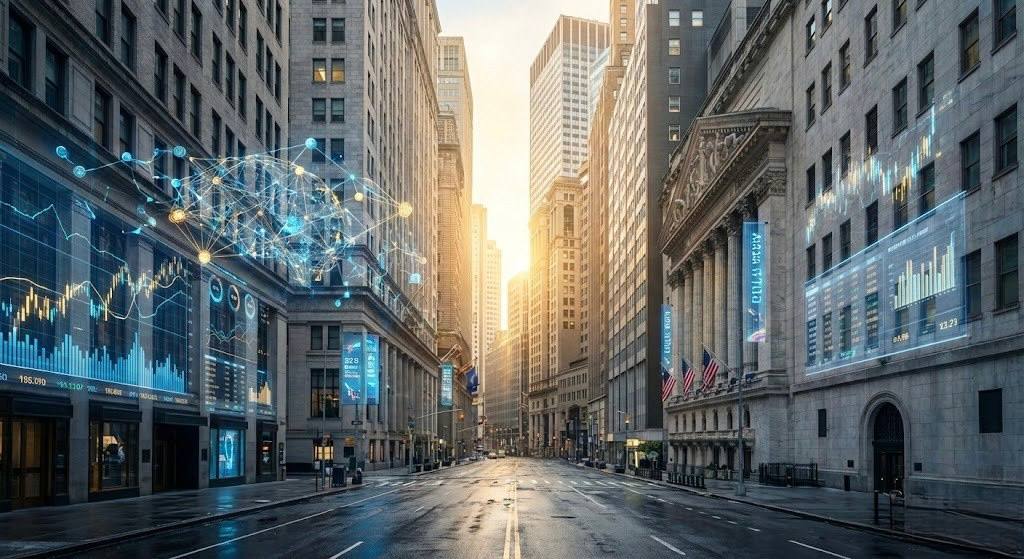
Wall Street’s 2026 outlook reveals a decisive shift in market focus. Bloomberg’s compilation of views from over 60 institutions shows artificial intelligence has become the defining theme for equity markets.
Last year, Trump policies dominated the conversation with AI playing a supporting role. This year, the dynamic has reversed completely.
Analysts now see tariffs and traditional macro drivers taking a backseat to one central question: How much will AI spending transform the economy?
Every Analyst Predicts a Rally
Bloomberg’s survey of 21 strategists produced a striking result. Every single participant expects the S&P 500 to rise in 2026. If realized, this would mark the fourth consecutive year of gains—a streak not seen in nearly two decades.
The average forecast points to a 9% advance. Price targets span a wide range:
- Oppenheimer: 8,100 (18% upside) Wall Street’s most bullish call
- Deutsche Bank: 8,000 (16% upside)
- Morgan Stanley: 7,800 (14% upside)
- JPMorgan: 7,500 (9% upside)
- Bank of America: 7,100 (4% upside) Most conservative estimate
Oppenheimer’s chief investment strategist John Stoltzfus bases his 8,100 target on earnings of $305 per share and a forward P/E of 26.5x. The firm cites persistent economic resilience and consistently stronger-than-expected corporate profits as key supports.
Deutsche Bank’s equity strategy team argues that if AI spending boosts productivity, GDP growth could exceed 4% echoing the late 1990s tech boom.
The $600 Billion Infrastructure Race
Wall Street’s AI optimism rests on concrete numbers. Goldman Sachs data shows the consensus estimate for hyperscaler capital spending in 2026 has climbed to $527 billion, up from $465 billion at the start of Q3 earnings season.
CreditSights projections paint an even more aggressive picture. The top five tech giants plan to spend over $602 billion in 2026 a 36% increase from 2025.
Approximately 75% of this total, or $450 billion, targets AI infrastructure directly: servers, GPUs, and data centers.
Amazon’s 2026 capex will exceed $125 billion. Microsoft signaled that fiscal 2026 spending growth will accelerate beyond fiscal 2025 levels. Meta CFO Susan Li stated capital expenditures will grow “notably larger.”
Goldman analysts highlight a critical pattern: Consensus estimates have consistently undershot actual spending for two years running.
Both 2024 and 2025 saw roughly 20% growth expected at year start, while realized figures exceeded 50%.
For investors seeking exposure to AI beneficiaries, our best AI stocks guide offers detailed analysis.
Fed Uncertainty Looms Large
One of 2026’s critical variables is Federal Reserve policy. Jerome Powell’s term as chair expires on May 15, 2026. The Trump administration plans to announce a nominee in January.
BlackRock analysts expect the Fed to pause rate cuts early in the year. Once a new chair takes office, one or two additional cuts could bring overnight rates closer to the 3% to 3.25% range.
The December meeting revealed sharp divisions. Three members dissented: Stephen Miran favored a 50 basis point cut while two others preferred holding rates steady. This split appears likely to persist into 2026.
Deutsche Bank’s chief U.S. economist Matthew Luzzetti warns that a new Fed chair may struggle to build consensus across a divided committee. If inflation remains elevated while the labor market softens, rate hikes could even return to the table.
Moody’s Analytics chief economist Mark Zandi offers a contrarian view. He expects three quarter-point cuts before midyear, driven by labor market weakness and political pressure.
Risks Remain on the Radar
Despite the optimism, analysts acknowledge significant risks.
JPMorgan puts the odds of a U.S. and global recession at 35%, citing sticky inflation and a softer labor market. Bank of America warns of an “AI air pocket” risk.
Goldman Sachs’ Kamakshya Trivedi frames the core danger bluntly: If expectations prove too optimistic, AI itself could become the largest threat to U.S. equities.
Valuation concerns persist. The S&P 500 currently trades above peaks seen in 2000 and 2022. Forward P/E ratios hover around 23x levels that historically limit future returns.
Fidelity International’s assessment captures the tension: A disconnect exists between the positive short-term environment for risk assets and broader structural instability. Global fragmentation, a depreciating dollar, and AI capex trends demand close monitoring.
The Bottom Line
2026 may mark the year artificial intelligence establishes undisputed dominance over Wall Street’s investment thesis. Every analyst surveyed expects gains, but the margin for error has narrowed considerably.
FactSet projects 15% earnings growth for S&P 500 companies. The Magnificent Seven are expected to grow earnings by 22.7%, while the remaining 493 firms should deliver 9.4% growth.
JPMorgan Wealth Management summarizes the prevailing sentiment: The biggest risk is not having exposure to this transformational technology.
Yet as valuations stretch and Fed policy remains uncertain, 2026 demands a delicate balance. Markets don’t need a crisis to fall they only need disappointment.