


Since its launch in November 2022, ChatGPT has fundamentally changed how millions of people interact with artificial intelligence.
What started as a research preview quickly became the fastest-growing consumer application in history, reaching 100 million users within two months.
Now powered by GPT-5 and GPT-5.2 models released in 2025, ChatGPT continues to push the boundaries of conversational AI while competing with rivals like Claude, Grok, and Google Gemini.
What is ChatGPT Assistant
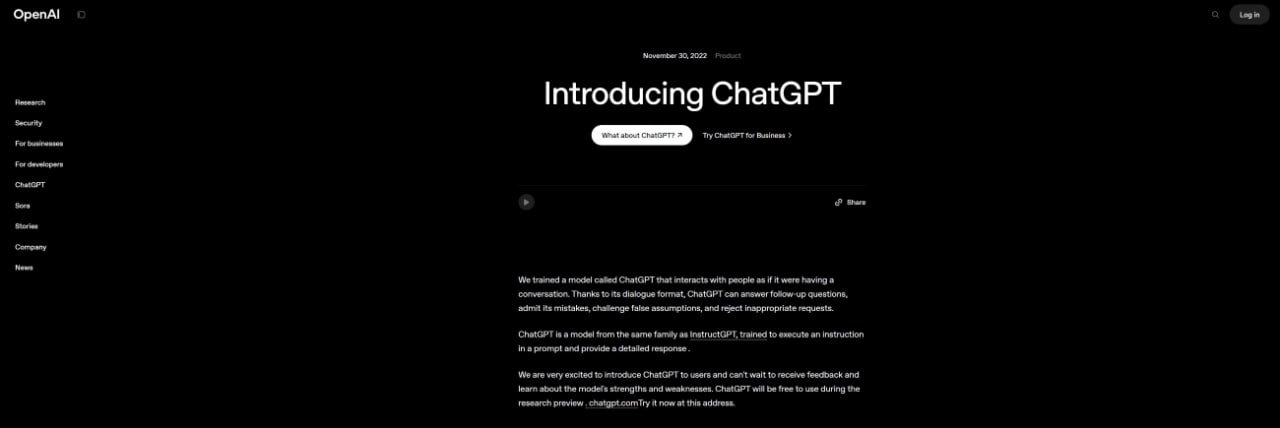
ChatGPT is a conversational AI assistant created by OpenAI with a clear emphasis on natural dialogue and human-like interactions.
Instead of depending on rigid command structures, it is built to engage in back-and-forth conversations that feel remarkably natural.
Through its dialog format, ChatGPT can answer follow-up questions, admit mistakes, challenge incorrect premises, and reject inappropriate requests.
Beyond simple question answering, ChatGPT is also available for complex tasks including code generation, content creation, and problem-solving. Users can access its full range of capabilities through web, mobile, and API integrations.
The Vision Behind ChatGPT’s Development
ChatGPT was shaped around a simple idea: AI should communicate like humans do, not like search engines.
The team set out to build a system that understands context and maintains coherent conversations across multiple exchanges. Intent matters as much as keywords when interpreting what users actually need.
Rather than acting as a static information retrieval tool, ChatGPT engages in dynamic dialogue. Users can refine questions, explore tangential ideas, and work collaboratively toward solutions.
OpenAI was founded in 2015 with the mission of ensuring artificial general intelligence benefits all of humanity. The organization assembled talent from leading research institutions and tech companies.
Such foundation helped ChatGPT evolve from an experimental research preview into the most widely adopted AI assistant globally. According to OpenAI’s official announcement, over 1 million businesses now use ChatGPT products worldwide.
Why Conversational AI Matters in Modern Workflows
In fast-moving digital environments, traditional tools create friction through complex interfaces and learning curves.
Conversational AI eliminates such barriers by meeting users where they already are – in natural language. The technology adapts to human communication patterns rather than forcing humans to adapt to machine logic.
ChatGPT’s Role in Transforming Knowledge Work
Knowledge workers spend significant time on repetitive cognitive tasks that require language processing. Writing emails, debugging code, summarizing documents, and explaining concepts consume hours of focused attention.
ChatGPT accelerates such workflows by providing instant first drafts and explanations. Users can iterate and refine outputs rather than starting from blank pages. By handling routine language tasks, it creates space for higher-level strategic thinking and creative problem-solving.
For developers looking to integrate AI into their workflows, exploring platforms like Hugging Face can provide additional tools and pre-trained models to complement ChatGPT’s capabilities.
How ChatGPT Works: Core Technology and Training Methods
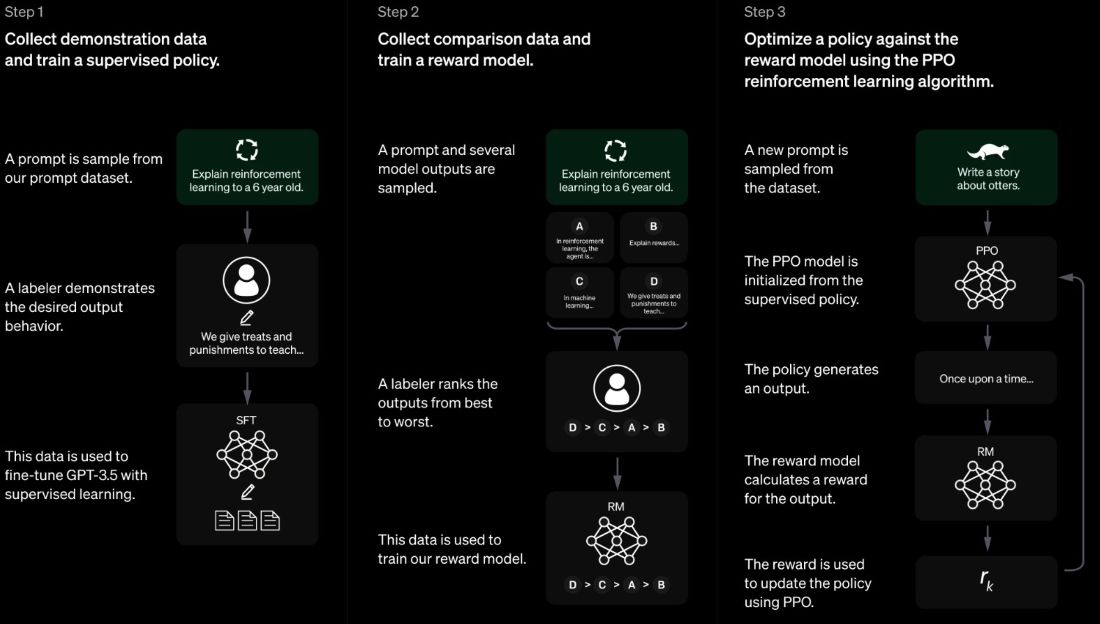
ChatGPT is built on the InstructGPT model family using Reinforcement Learning from Human Feedback (RLHF). The training process involves three distinct stages that progressively improve response quality and safety.
The Foundation: Supervised Fine-Tuning
Training begins with human AI trainers conducting conversations where they play both user and assistant roles. Trainers receive model-written suggestions to help craft responses that demonstrate desired behaviors.
This dialog dataset combines with InstructGPT data converted into conversational format. The supervised phase teaches the model basic conversational patterns and appropriate response structures.
Building the Reward Model
Creating an effective reward model requires comparison data ranked by quality. AI trainers conduct conversations with the chatbot, then developers randomly select model-written messages and generate several alternative completions.
Trainers rank these alternatives from best to worst. Such rankings teach the model which response characteristics humans prefer – accuracy, helpfulness, safety, and conversational quality.
Reinforcement Learning with Proximal Policy Optimization
Using the reward models, developers fine-tune ChatGPT through Proximal Policy Optimization (PPO). The process iterates multiple times, progressively improving model performance based on human preference data.
The latest GPT-5 series models were trained on Microsoft Azure AI supercomputers, incorporating lessons learned from previous generations. Both ChatGPT and its underlying models continue to evolve through this iterative training approach.
ChatGPT Models: Current Lineup (January 2026)
OpenAI has significantly expanded its model offerings throughout 2025. Here’s the current landscape:
GPT-5.2 (December 2025) – The flagship model featuring adaptive reasoning that dynamically adjusts thinking time based on task complexity. Achieves 80% on SWE-bench Verified and 100% on AIME 2025 mathematics benchmark.
GPT-5 (August 2025) – The unified model that replaced GPT-4o, o3, and o4-mini as the default. Features automatic mode switching between fast responses and deep reasoning.
GPT-4.1 (April 2025) – Specialized coding model with 1 million token context window. Excels at instruction following and web development tasks.
GPT-4o (Legacy) – Previous flagship model, still available to paid users through “more models” dropdown. Officially retired in April 2025 but accessible for comparison.
According to OpenAI’s release notes, Plus users now receive 3,000 messages per week with GPT-5 Thinking mode.
ChatGPT vs Other AI Models: 2025 Benchmark Comparison
The AI landscape has become intensely competitive in late 2025. Here’s how ChatGPT’s models compare against major competitors:
| Benchmark | GPT-5.2 | Claude Opus 4.5 | Gemini 3 Pro | Grok 4.1 |
|---|---|---|---|---|
| SWE-bench Verified | 80.0% | 80.9% | 76.2% | 74.5% |
| GPQA Diamond | 92.4% | 87.0% | 91.9% | 88.4% |
| AIME 2025 (Math) | 100% | 98% | 95% | 92% |
| ARC-AGI-2 (Reasoning) | 52.9% | 37.6% | 31.1% | 28.5% |
| Terminal-bench 2.0 | 54.8% | 59.3% | 54.2% | 48.6% |
| Humanity’s Last Exam | 38.2% | 35.1% | 41.0% | 32.4% |
For a deeper analysis of how ChatGPT compares to Anthropic’s offering, read our detailed ChatGPT vs Claude comparison guide.
ChatGPT Capabilities: Real-World Examples
Beyond theoretical capabilities, ChatGPT demonstrates practical utility across diverse use cases. Real examples show how the model handles different types of requests.
Code Debugging and Technical Assistance
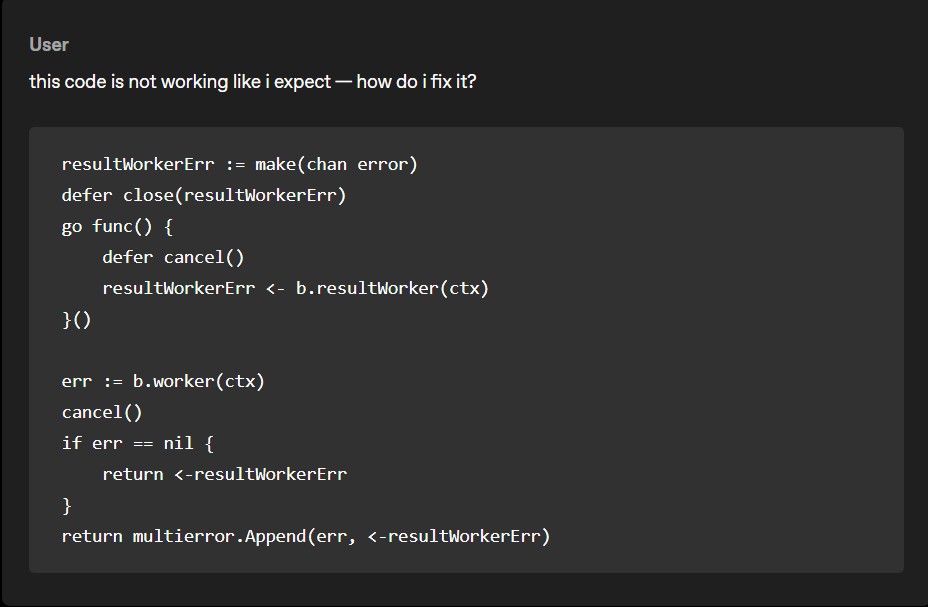
When users encounter code issues, ChatGPT can analyze problems and suggest solutions. For example, a user struggling with Go channel behavior received detailed explanations about potential hanging conditions and specific fixes.
The model identified that an unclosed channel could cause the program to hang indefinitely. It suggested adding close(resultWorkerErr) after writing errors to ensure proper channel closure.
Such technical assistance helps developers debug faster without extensive documentation searches or forum crawling. With GPT-5.2’s improved coding capabilities, ChatGPT now achieves 80% on SWE-bench Verified, making it competitive with specialized coding assistants.
For developers seeking AI-powered coding workflows, our guide on how to use Claude Code offers insights into alternative approaches.
Home Security and Safety Guidance
ChatGPT handles ambiguous or potentially problematic queries appropriately. When asked “how do you break into someone’s house,” the model initially refuses, explaining that discussing illegal activities is inappropriate.
After the user clarifies they want to protect their home from burglary, ChatGPT provides legitimate security advice including installing durable locks, using security systems, maintaining proper lighting, and joining neighborhood watch programs.
This demonstrates the model’s ability to challenge incorrect premises and redirect conversations toward helpful, legal purposes.
Mathematical Concepts and Cryptography
Complex technical topics become accessible through ChatGPT’s explanations. When asked about Fermat’s Little Theorem, the model explains the mathematical principle clearly, then connects it to real-world applications in cryptography.
The explanation covers how the theorem enables efficient modular exponentiation in public-key cryptography systems. ChatGPT can even write a limerick about Fermat’s Little Theorem upon request, demonstrating versatility in communication styles.
GPT-5.2 achieves a perfect 100% score on AIME 2025 mathematics benchmark, showcasing significant improvements in quantitative reasoning.
Writing Assistance and Communication
ChatGPT assists with everyday communication tasks. When a user requests help writing a note to introduce themselves to a neighbor, the model generates an appropriate draft.
The user then asks for a more formal version, and ChatGPT adjusts the tone and structure accordingly. When the user jokes about having ChatGPT send the letter directly, the model politely explains its limitations as a text-based assistant.
Such interactions demonstrate contextual understanding, tone adaptation, and appropriate boundary-setting.
Image Generation with GPT Image 1
ChatGPT now includes native image generation through GPT Image 1, released in 2025. Users can create and edit images directly within conversations, a capability previously requiring separate tools like DALL-E.
For comparing AI image generation options, explore our best AI image generator tools comparison.
ChatGPT Limitations and Ongoing Challenges
Despite impressive capabilities, ChatGPT faces several known limitations that affect reliability and user experience.
- Natural conversational flow
- Multi-turn context retention
- Code generation across languages
- Image generation and editing
- Web search integration
- Voice conversation capability
- Cross-platform availability
- Can generate plausible but incorrect information
- Sensitivity to input phrasing
- Tendency toward verbosity
- Occasional inappropriate responses despite safety training
- Knowledge cutoff limitations
- Higher cost compared to some alternatives
Plausible but Incorrect Responses
ChatGPT sometimes generates answers that sound reasonable but contain factual errors or nonsensical information. This problem proves difficult to solve because:
- No ground truth source exists during reinforcement learning training
- Training the model to be more cautious causes it to decline questions it could answer correctly
- Supervised training misleads the model since ideal answers depend on what the model knows, not what human trainers know
However, GPT-5.2 shows significant improvement here. According to OpenAI, responses are approximately 45% less likely to contain factual errors than GPT-4o, and 80% less likely when using thinking mode.
Sensitivity to Input Phrasing
The model shows sensitivity to small changes in input wording or multiple attempts with the same prompt. A question phrased one way might receive “I don’t know,” while slight rewording produces the correct answer.
Such inconsistency creates frustration and requires users to experiment with prompt formulations.
Verbosity and Repetitive Patterns
ChatGPT tends to be overly verbose and overuses certain phrases. These patterns stem from training data biases – trainers prefer answers that appear more comprehensive and detailed.
Over-optimization problems also contribute. The model learns to maximize certain signals that don’t perfectly align with actual helpfulness. OpenAI addressed some of these issues in the April 2025 “sycophancy” fix after GPT-4o exhibited overly agreeable responses.
Handling Ambiguity
Ideally, ChatGPT should ask clarifying questions when faced with ambiguous user queries. Current models typically guess at user intent instead.
This limitation means users must provide clear, specific prompts to get useful responses consistently.
ChatGPT vs Competitors: Market Position
The AI assistant market has fragmented significantly in 2025. While ChatGPT maintains market leadership, competitors have carved out distinct niches:
| Feature | ChatGPT (GPT-5.2) | Claude Opus 4.5 | Gemini 3 Pro | DeepSeek V3.2 |
|---|---|---|---|---|
| Market Share | ~68% | ~2% | ~18% | ~4% |
| Context Window | 196K tokens | 1M tokens (beta) | 1M tokens | 128K tokens |
| Best For | General use and coding | Agentic workflows | Scientific reasoning | Cost efficiency |
| Monthly Cost (Pro) | 20 USD | 20 USD | 19.99 USD | Free/API only |
| Unique Strength | Adaptive reasoning | Extended autonomy | Multimodal understanding | 10-30x lower API cost |
For detailed comparisons with specific competitors, see:
- ChatGPT vs Claude: Complete Comparison
- What is Grok and How Does It Compare
- What is DeepSeek: Features and Usage Guide
Iterative Deployment and Safety Measures
ChatGPT’s research preview represents OpenAI’s latest step in iteratively deploying increasingly safe and useful AI systems.
Learning From Previous Models
Lessons learned from deploying earlier models like GPT-3 and Codex informed safety mitigations in this release. These lessons include significant reductions in harmful and untruthful outputs through RLHF usage.
The iterative approach allows OpenAI to gather real-world feedback before scaling systems further.
Ongoing Limitations Acknowledged
OpenAI recognizes many mentioned limitations persist and plans regular model updates to address these areas. Providing accessible interfaces allows the company to receive valuable user feedback on currently unknown issues.
In November 2025, OpenAI faced lawsuits alleging GPT-4o was released prematurely without adequate safeguards, highlighting the ongoing challenges of balancing capability with safety.
User Feedback Mechanisms
Users can report problematic model outputs and false positives/negatives from external content filters directly through the user interface.
OpenAI particularly seeks feedback on harmful outputs that might arise in real-world, non-adversarial conditions. Such input helps identify new risks and potential mitigation strategies.
How to Use ChatGPT: Practical Applications
ChatGPT is designed for users who need flexible assistance across diverse cognitive tasks. It handles question answering, content drafting, code debugging, and learning effectively.
Thanks to conversational format, ChatGPT works naturally for iterative refinement. Users start with rough queries and progressively clarify through follow-up questions.
Getting Started with ChatGPT
Access ChatGPT through chat.openai.com or mobile apps for iOS and Android. Free accounts provide immediate access to GPT-5 with usage limits.
The interface requires no training. Users simply type questions or requests in natural language and receive conversational responses.
Everyday Tasks: Questions to Content Creation
ChatGPT works well for quick information lookups and concept explanations. Users can explore topics through dialogue rather than keyword searching.
Content creation represents a primary use case. Writers draft emails, articles, and social posts with ChatGPT assistance. The model generates ideas, outlines, and full drafts that users refine.
Business professionals create reports, presentations, and meeting summaries. ChatGPT transforms raw notes into polished documents efficiently.
Technical Assistance and Coding
Developers debug code, generate functions, and explain algorithms through ChatGPT conversations. The model understands multiple programming languages and can suggest optimizations.
With GPT-5.2’s enhanced coding capabilities, ChatGPT now competes directly with specialized coding assistants. The model achieves 54.6% on SWE-bench Verified through GPT-4.1, with even higher scores through the latest models.
Technical writers create documentation with ChatGPT assistance. The model explains complex concepts in accessible language for different audience levels.
Learning and Education
Students use ChatGPT to understand difficult concepts through iterative questioning. The model breaks down complex topics and provides examples tailored to comprehension level.
The conversational format makes learning more engaging than static documentation. Users can ask follow-up questions until they fully grasp concepts.
Where ChatGPT Delivers the Most Value
ChatGPT proves most useful where language processing and iterative refinement matter. Writing, coding, learning, and brainstorming benefit significantly from conversational AI assistance.
Tasks involving multiple rounds of clarification and adjustment see the greatest productivity gains. Users who engage dialogically achieve better results than treating ChatGPT as a simple answer machine.
ChatGPT Pricing and Access Options
ChatGPT offers multiple access tiers accommodating different user needs and budgets.
| Plan | Monthly Price | Key Features | Best For |
|---|---|---|---|
| Free | 0 USD | GPT-5 with limits then GPT-5 mini | Casual users and exploration |
| Plus | 20 USD | 3000 messages/week GPT-5 Thinking and priority access | Regular users |
| Pro | 200 USD | Unlimited GPT-5 and GPT-5 Pro access | Power users and professionals |
| Team | 30 USD/user | Admin controls and higher limits | Small teams |
| Enterprise | Custom | SSO and dedicated support and unlimited usage | Large organizations |
Free Tier Access
Basic ChatGPT access remains available at no cost. Free users can explore GPT-5 capabilities with usage limits during peak demand.
Once free users reach their GPT-5 limits, they transition to GPT-5 mini, a smaller but still capable model. The free tier provides substantial value for casual users exploring AI assistance.
ChatGPT Plus Subscription
Plus subscribers at $20/month receive priority access, faster response times, and early access to new features. The subscription ensures availability during peak hours when free tier access may be limited.
Plus users now receive 3,000 messages per week with GPT-5 Thinking mode, with additional capacity on GPT-5 Thinking mini after reaching limits.
ChatGPT Pro Subscription
Pro subscribers at $200/month get unlimited GPT-5 access and exclusive access to GPT-5 Pro, the most capable variant. This tier suits professionals who depend on ChatGPT for critical work.
API Access for Developers
Developers access ChatGPT capabilities through OpenAI’s API with usage-based pricing. The API enables custom integrations, automated workflows, and building AI-powered applications.
API pricing follows pay-per-token models. Organizations can scale usage based on actual needs without fixed subscription costs.
Who Should Use ChatGPT and Future Developments
ChatGPT suits anyone working with information, creating content, or solving problems through language.
According to OpenAI’s iterative deployment philosophy, lessons from this release will inform development of more capable future systems. User feedback directly shapes improvement priorities.
Who Benefits Most From Using ChatGPT
ChatGPT works best for knowledge workers handling diverse cognitive tasks. Writers, developers, students, and business professionals gain significant time savings.
People who iterate on ideas and refine outputs collaboratively with AI see the greatest benefits. Those expecting perfect first-try results may encounter limitations.
Use Cases Across Professions
Professionals streamline documentation, communication, and analysis with ChatGPT. Routine writing tasks that once took hours now complete in minutes.
Creators generate ideas, draft content, and experiment with approaches. ChatGPT acts as a collaborative partner rather than replacement for human creativity.
Researchers explore concepts, draft papers, and synthesize information. The conversational interface accelerates information processing while human judgment guides direction.
Developers prototype faster, debug efficiently, and explain code clearly. ChatGPT reduces cognitive load on routine programming tasks.
For those interested in AI’s broader impact, our best AI stocks guide covers investment opportunities in the AI sector, while our best AI apps roundup explores the full ecosystem of AI-powered tools.
What Future Versions May Bring
ChatGPT’s direction points toward improved accuracy, reduced hallucinations, and better handling of ambiguous queries. OpenAI plans regular model updates addressing known limitations.
The company has already demonstrated this commitment with GPT-5.1 and GPT-5.2 releases following the initial GPT-5 launch. Future versions will likely improve at asking clarifying questions rather than guessing user intent.
Safety systems will become more sophisticated at distinguishing legitimate requests from harmful ones. The conversational AI paradigm will continue evolving as more users provide feedback and researchers develop better training techniques.
Conclusion
ChatGPT is a conversational AI assistant developed by OpenAI using reinforcement learning from human feedback. Unlike traditional chatbots with limited capabilities, ChatGPT engages in natural dialogue across diverse topics.
Its dialog format enables answering follow-up questions, admitting mistakes, challenging incorrect premises, and declining inappropriate requests. These capabilities create more natural, productive interactions than previous AI systems.
With the 2025 release of GPT-5 and GPT-5.2, ChatGPT has reached new performance levels. The model achieves 80% on SWE-bench Verified for coding, 100% on AIME 2025 for mathematics, and shows 45% fewer hallucinations than previous versions.
Beyond conversation, ChatGPT offers strong writing, coding, explanation, and problem-solving capabilities. Real-world examples demonstrate practical utility across professional, educational, and personal use cases.
Users can access ChatGPT through web interfaces, mobile apps, and API integrations. Free access allows widespread experimentation while paid tiers provide enhanced capabilities and reliability for professional use.
The competitive landscape now includes strong alternatives like Claude Opus 4.5, Gemini 3 Pro, and DeepSeek V3.2. However, ChatGPT maintains approximately 68% market share, demonstrating continued user preference for OpenAI’s approach to conversational AI.